Tutored schools’ GPA jumped 36 points — case closed?
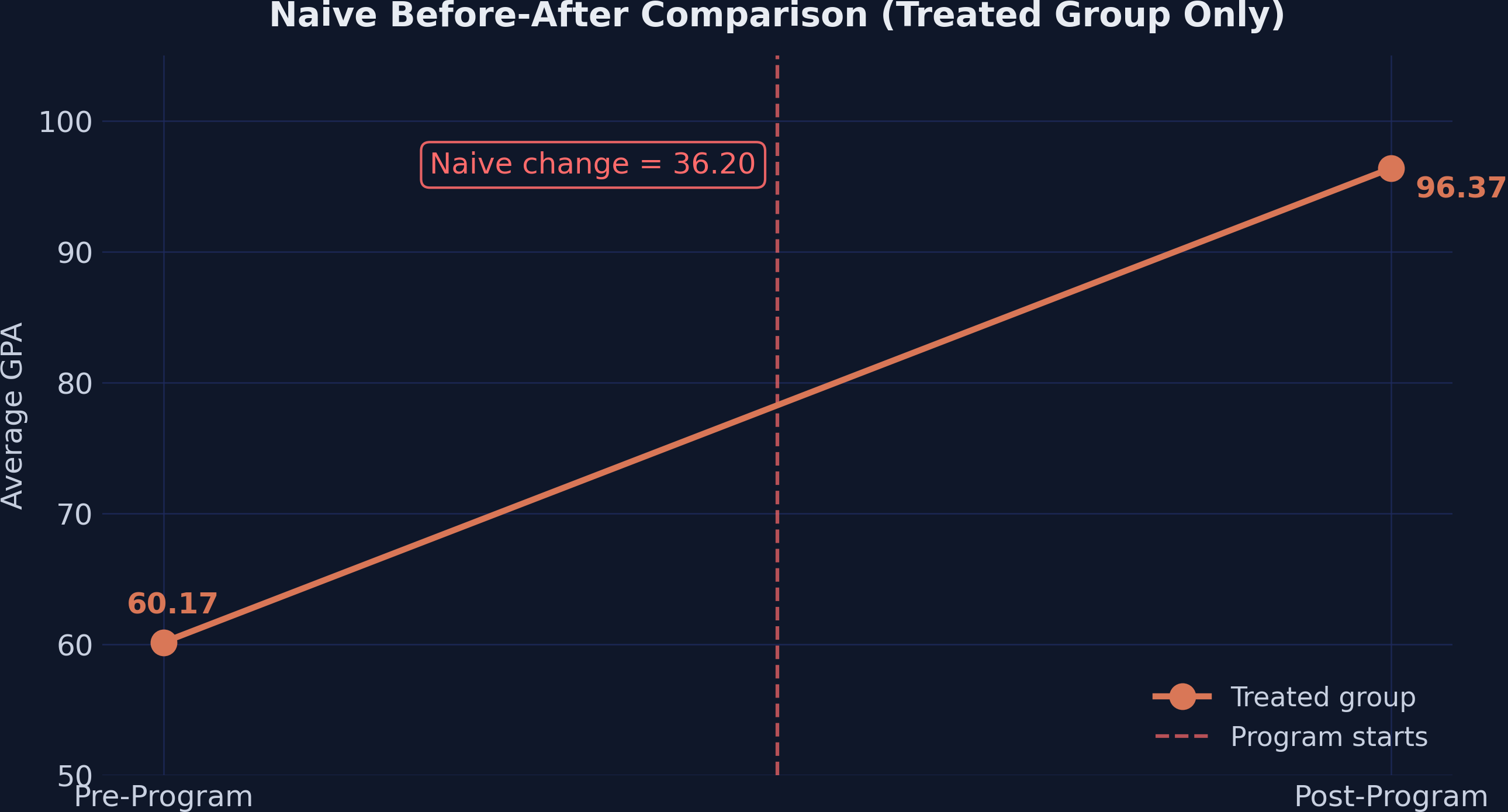
A district launched after-school tutoring in 10 of its 35 high schools. One year later, average GPA in those schools rose from 60.17 to 96.37.
A 36.20-point leap. But the 25 untreated schools also improved — from 71.22 to 82.10. How much of the jump is really the program?
The naive before-after attributes the entire 36-point rise to the program
Treated-group GPA rising from 60.17 to 96.37 — the naive estimator credits the full 36.20-point increase to tutoring, ignoring everything else that changed.
The plan: from naive before-after to an 8-period event study
The lab: a 35-school, 2-period panel — a clean 2×2 design
Why naive before-after overstates, and how a comparison group fixes it
Manual double-differencing, then OLS and two-way fixed effects in PyFixest
Four standard-error flavours — does inference change the verdict?
An 8-period event study to test parallel trends
The Investigation
Act II
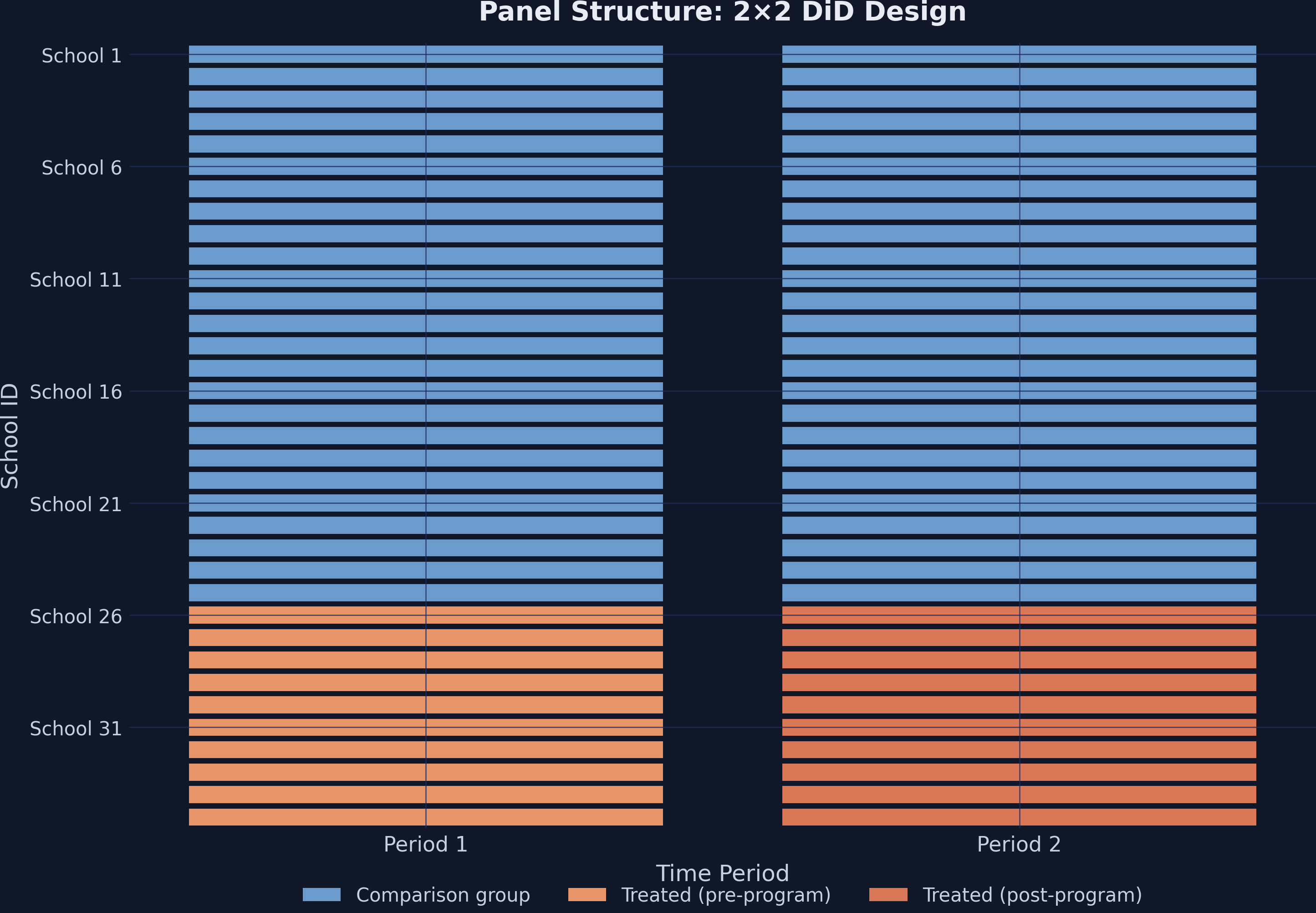
A clean 2×2 lab: 35 schools, 2 periods, simultaneous treatment
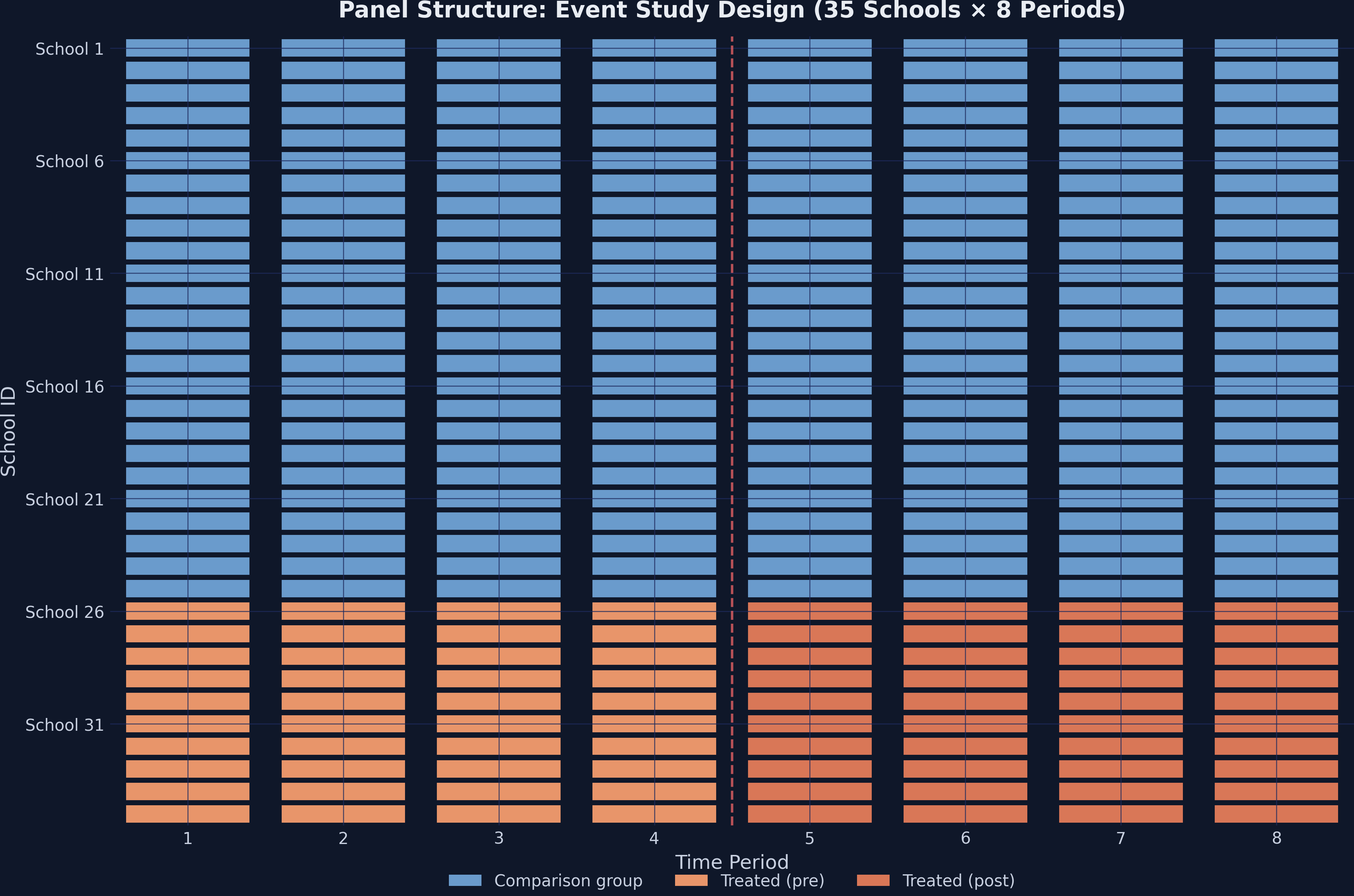
Panel structure — 10 treated schools (orange) switch on after the intervention; 25 comparison schools (steel blue) never do. No school changes status, and timing is simultaneous.
The comparison group reveals an 11-point trend the program never caused
Group
Pre
Post
Change
Comparison (25)
71.22
82.10
+10.88
Treated (10)
60.17
96.37
+36.20
The comparison group’s +10.88 is the secular trend — the rise that would have happened anyway.
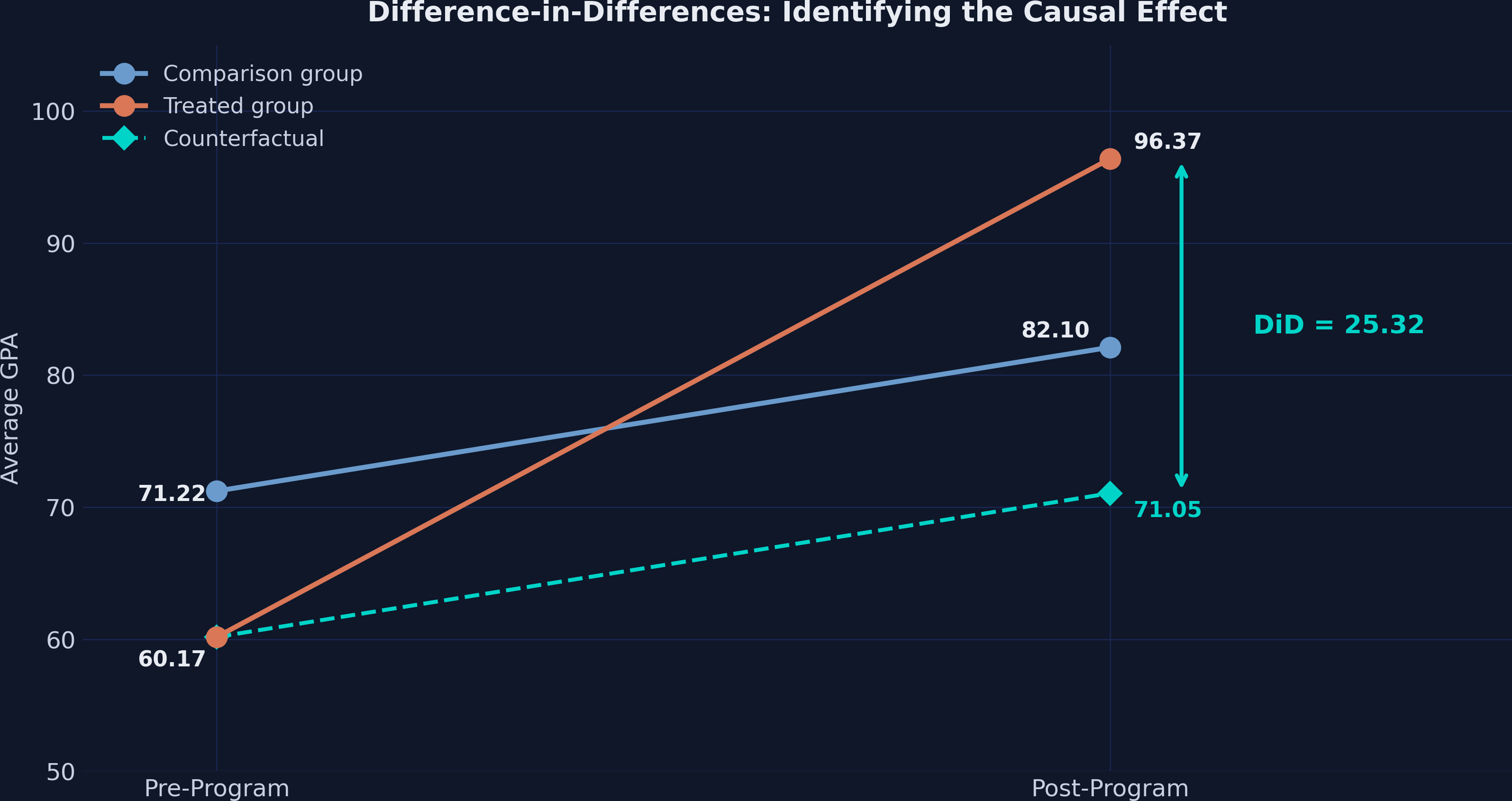
DiD is a double difference: 36.20 minus 10.88 equals 25.32
Subtract the trend the control group reveals; what’s left is the program’s causal effect.
The counterfactual: where treated schools would have landed without tutoring
Three lines — comparison (steel, 71.22→82.10), treated (orange, 60.17→96.37), and the counterfactual (teal dashed, 60.17→71.05). The 25.32 gap between the actual and counterfactual treated outcome is the ATT.
DiD identifies the ATT, not the ATE, under parallel trends
The change in untreated potential outcomes is the same for both groups — so the control’s trend stands in for the treated group’s missing counterfactual.
The estimand is the ATT: the average effect for the schools that actually got the program.
A treated×post interaction recovers the same 25.32 — with every coefficient a group mean
\(\gamma_i\) wipes school stains, \(\vartheta_t\) wipes period glare. PyFixest’s | pipe absorbs both — no dummy bookkeeping.
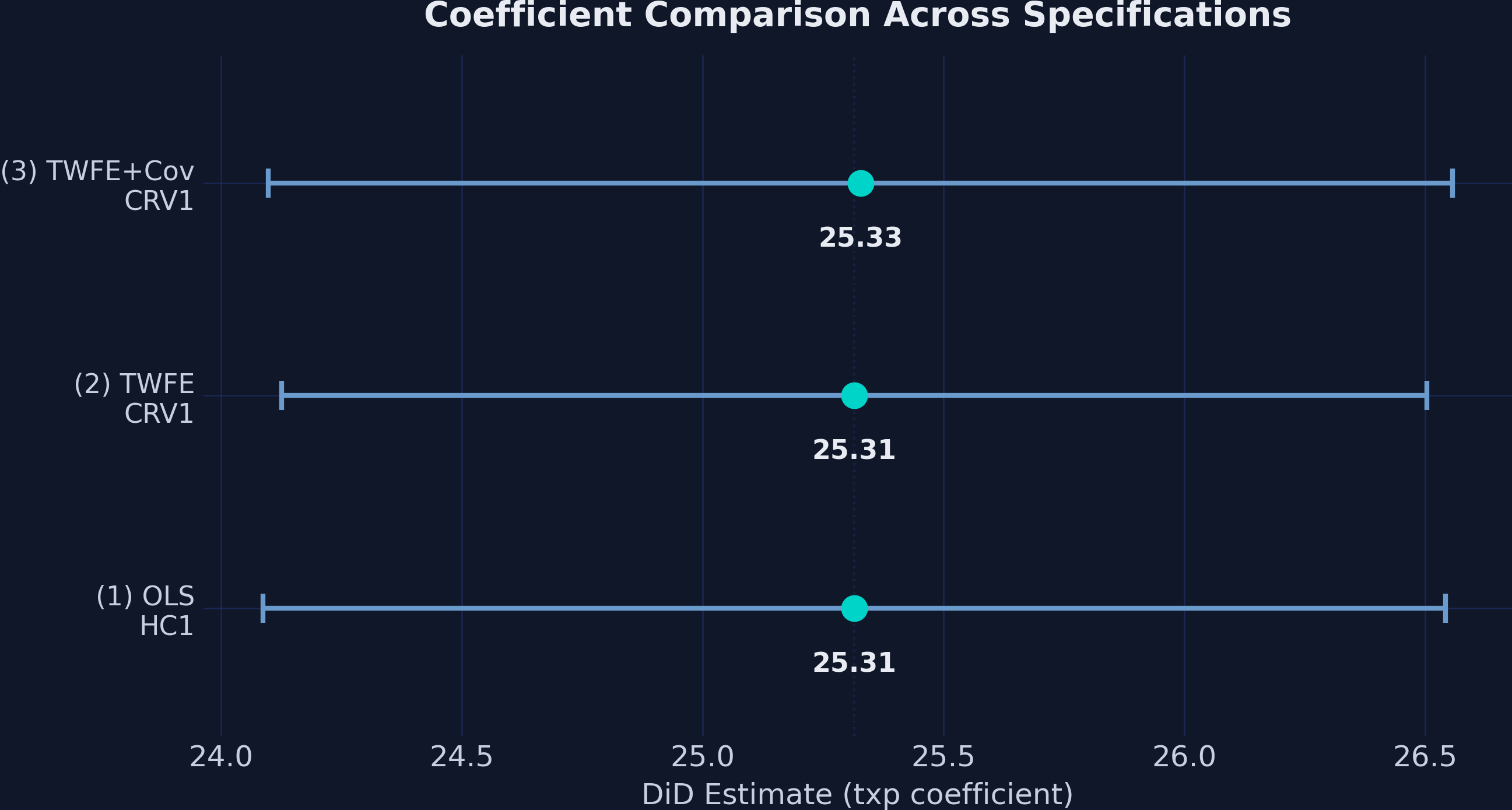
Three specifications, one answer: 25.315 to 25.328
The txp estimate across OLS/HC1, TWFE/CRV1, and TWFE+covariate/CRV1 — all clustered tightly around 25.32 with narrow CIs nowhere near zero.
Inference flavours barely move the needle when the signal is this strong
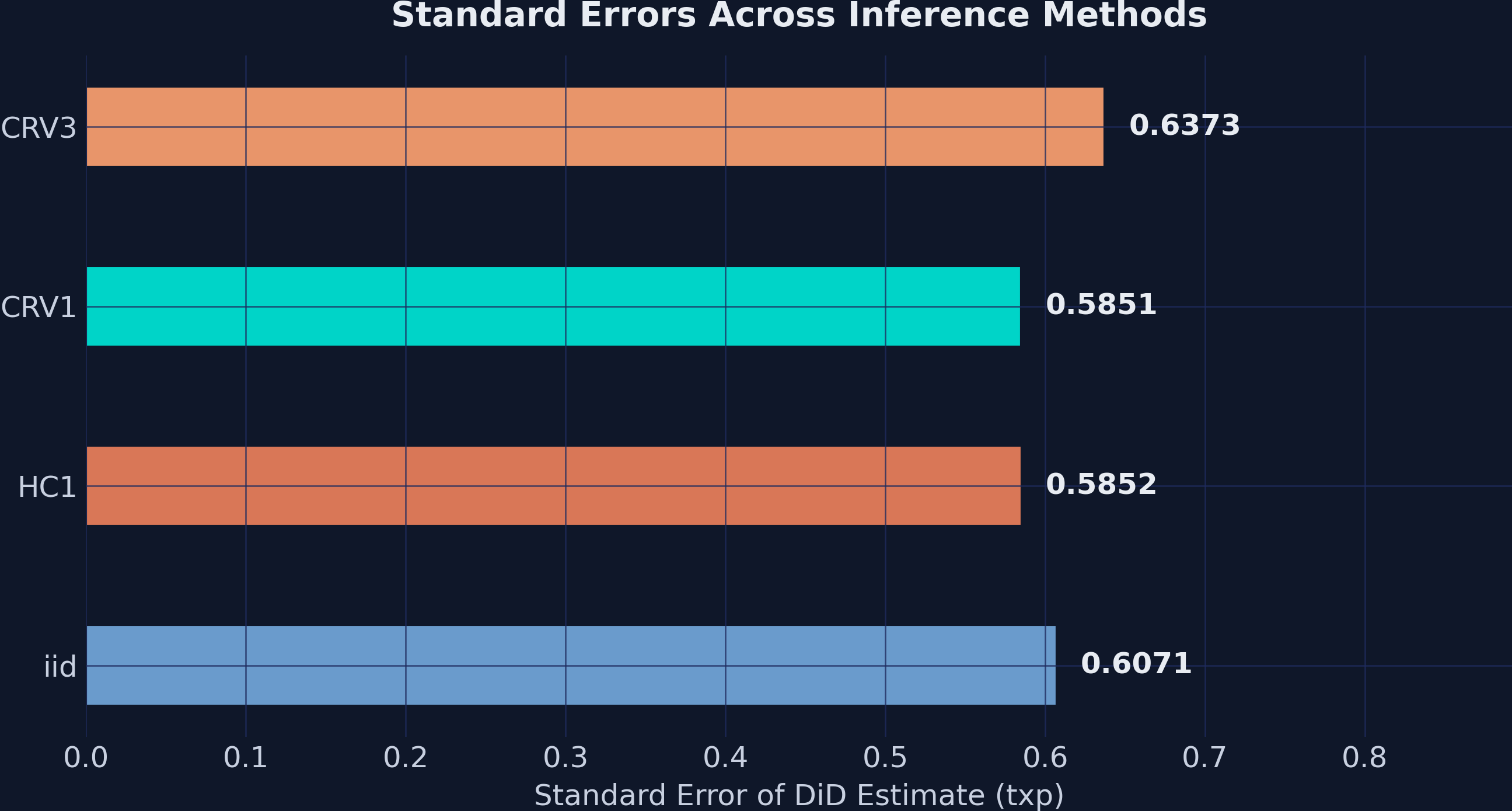
Standard errors across iid, HC1, CRV1, and CRV3. CRV3 is largest (0.637); HC1 and CRV1 are nearly identical (0.585). All four yield overwhelmingly significant results.
The Resolution
Act III
The program raises GPA by 25.32 points — not 36.20
25.32
ATT, stable across specifications (25.315–25.328) · the naive 36.20 overstated it by 43%
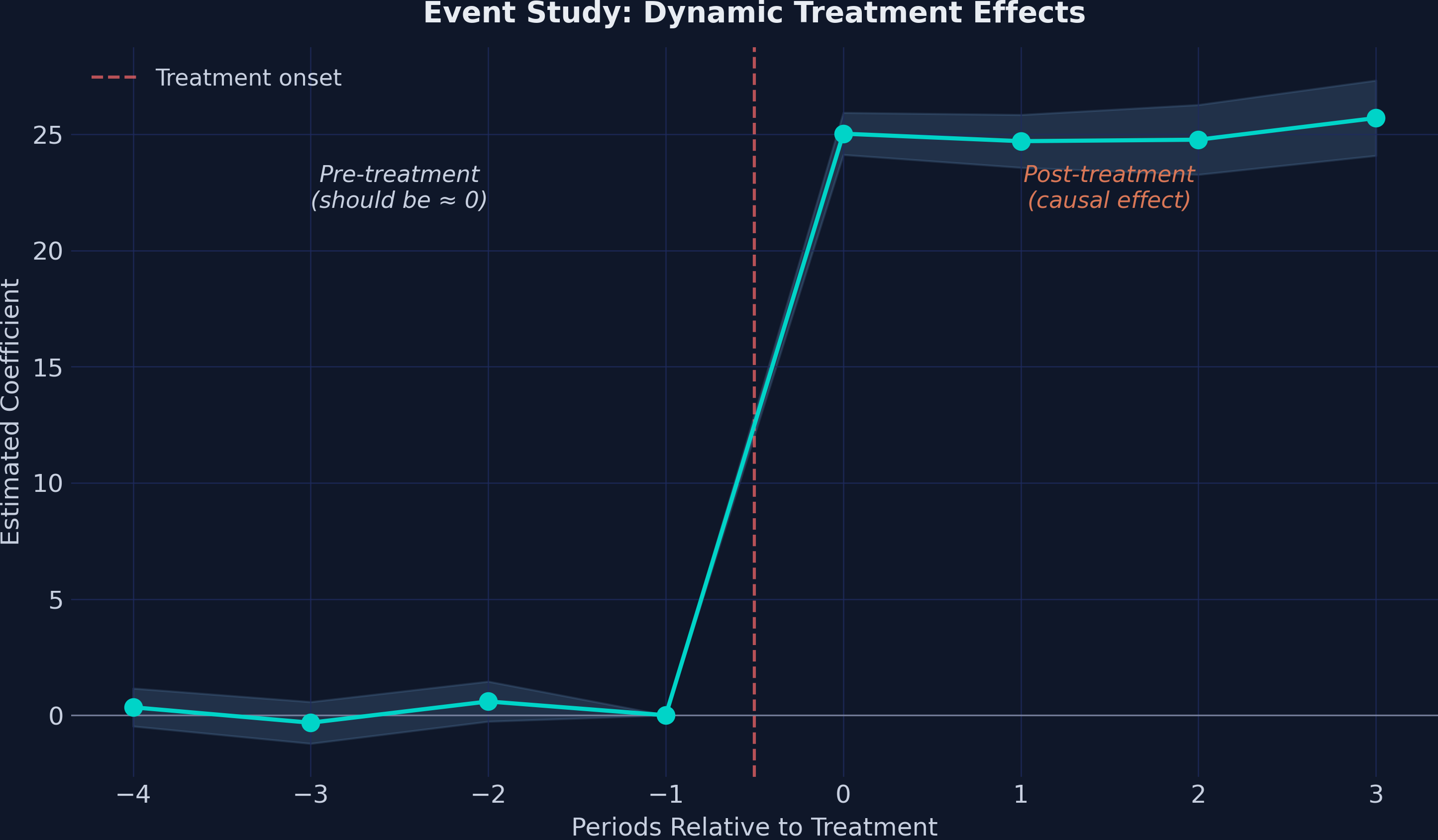
Pre-trends are flat and effects jump immediately — a textbook event study
Event-study coefficients by period relative to treatment. Leads (t = −4 to −2) sit near zero with CIs covering zero; lags (t = 0 to 3) jump to ≈25 and stay flat.
The numbers behind the picture: silent leads, loud lags
Period
Estimate
95% CI
Significant?
t = −4
0.34
[−0.47, 1.16]
no
t = −3
−0.32
[−1.22, 0.57]
no
t = −2
0.59
[−0.27, 1.45]
no
t = 0
25.03
[24.12, 25.93]
yes
t = 3
25.70
[24.08, 27.32]
yes
Three near-zero leads validate parallel trends; four large lags trace a stable effect.
Event-study panel confirms the design: treatment switches on at period 5
Panel structure for the event study — 35 schools across 8 periods. Treatment begins at period 5; 10 treated schools switch from light to dark orange, 25 comparison schools stay steel blue.
Does precision make this causal? No — the assumptions still carry it
Objection. The estimate is precise and the pre-trends are flat — surely DiD has proven tutoring caused the gain.
Response. Precision is not identification. The 25.32 ATT is valid only under parallel trends and SUTVA. Flat pre-trends are supportive, not proof; and this is simulated data with parallel trends built in. In the field, expect imperfect pre-trends, smaller effects, and R² well below 0.99.
A credible comparison group, not the variance estimator, is what makes the effect causal.