The lab: 48 states × 12 years, 576 rows, 284 candidate controls
Outcome — one of three crime rates (violent, property, murder)Treatment — the “effective abortion rate”Controls — 8 original covariates expanded to 284 (lags, interactions, trends)
\(p/n \approx 0.49\) — the high-dimensional regime where Double LASSO is meant to help.
State fixed effects are absorbed by first-differencing; year effects are partialled out via Frisch–Waugh–Lovell before the LASSO sees the data.
Five estimators ask the same question with escalating discipline
First-difference OLS — no controls (the Donohue–Levitt baseline)Kitchen-sink OLS — all 284 controls at oncePSL — one LASSO, treatment forced inDouble LASSO (rigorous) — two LASSOs, theory-chosen penaltyDouble LASSO (CV) — two LASSOs, cross-validated penalty
Same question, escalating discipline — from zero controls to two theory-tuned LASSOs.
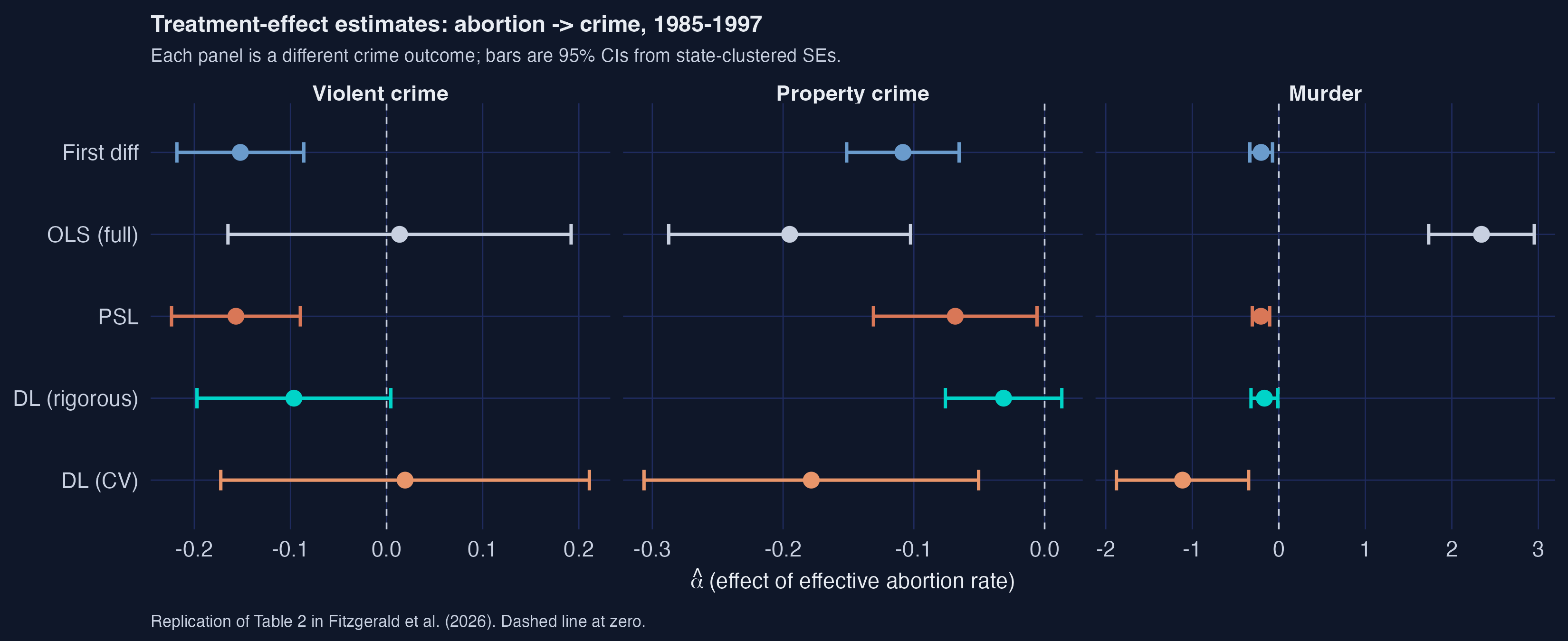
With zero controls, more abortion tracks less crime: −0.152
Violent
−0.152 0.034
yes
Property
−0.108
0.022
yes
Murder
−0.204
0.067
yes
This is the result the four LASSO methods stress-test — not one they generate.
All three negative and significant with state-clustered standard errors (48 clusters). A one-unit rise in the differenced abortion rate ≈ a 15% fall in violent crime. Does this survive adding 284 controls?
Throw in all 284 controls and OLS claims abortion raises murder by 234%
+2.34
Kitchen-sink OLS, murder (\(\hat\alpha\) ); violent crime flips sign to +0.014
p = 284 < n = 576, so OLS technically inverts — but near-collinear controls make the estimate nonsense and the SEs balloon (R silently drops 3 rank-deficient columns). The cautionary tale that motivates disciplined selection.
Double LASSO selects on the outcome and the treatment, then runs OLS
\[\hat\beta(\lambda)=\arg\min_\beta\ \frac{1}{2n}\sum_{i=1}^{n}\big(y_i-x_i^\top\beta\big)^2+\lambda\sum_{j=1}^{p}|\beta_j|\]
Run two LASSOs: \(y\) on \(X\) → \(I_y\) , and \(d\) on \(X\) → \(I_d\) .
Then OLS of \(y\) on \(d\) and the union \(I_y\cup I_d\) .
The L1 penalty \(\lambda\sum_j|\beta_j|\) zeroes weak controls; the union keeps anything that predicts either side.
PSL selects only on y, so it can drop a control that predicts the treatment but not the outcome — exactly the omitted variable that biases α. Double LASSO’s second LASSO (d on X) catches it. Frisch–Waugh–Lovell guarantees the post-OLS α is unbiased if the union captures the confounding.
Six lines fit the rigorous Double LASSO in R
library (hdm); library (sandwich); library (lmtest)<- which (rlasso (X, y)$ index) # controls that predict crime <- which (rlasso (X, d)$ index) # controls that predict abortion <- union (Iy, Id) # the union is the Double LASSO safeguard <- lm (y ~ d + X[, S]) # post-OLS on the selected support coeftest (fit, vcov = vcovCL, cluster = state)["d" , ]Two rlasso fits, their union, one post-OLS — the entire estimator in six lines.
“Rigorous” means hdm::rlasso chooses λ from Belloni et al.’s theory (c = 1.1, γ = 0.05), not from cross-validation. The post-OLS step is load-bearing: α comes from unshrunk OLS on the selected support, never from LASSO’s shrunk coefficients.
Theory keeps 8 controls; cross-validation keeps 150
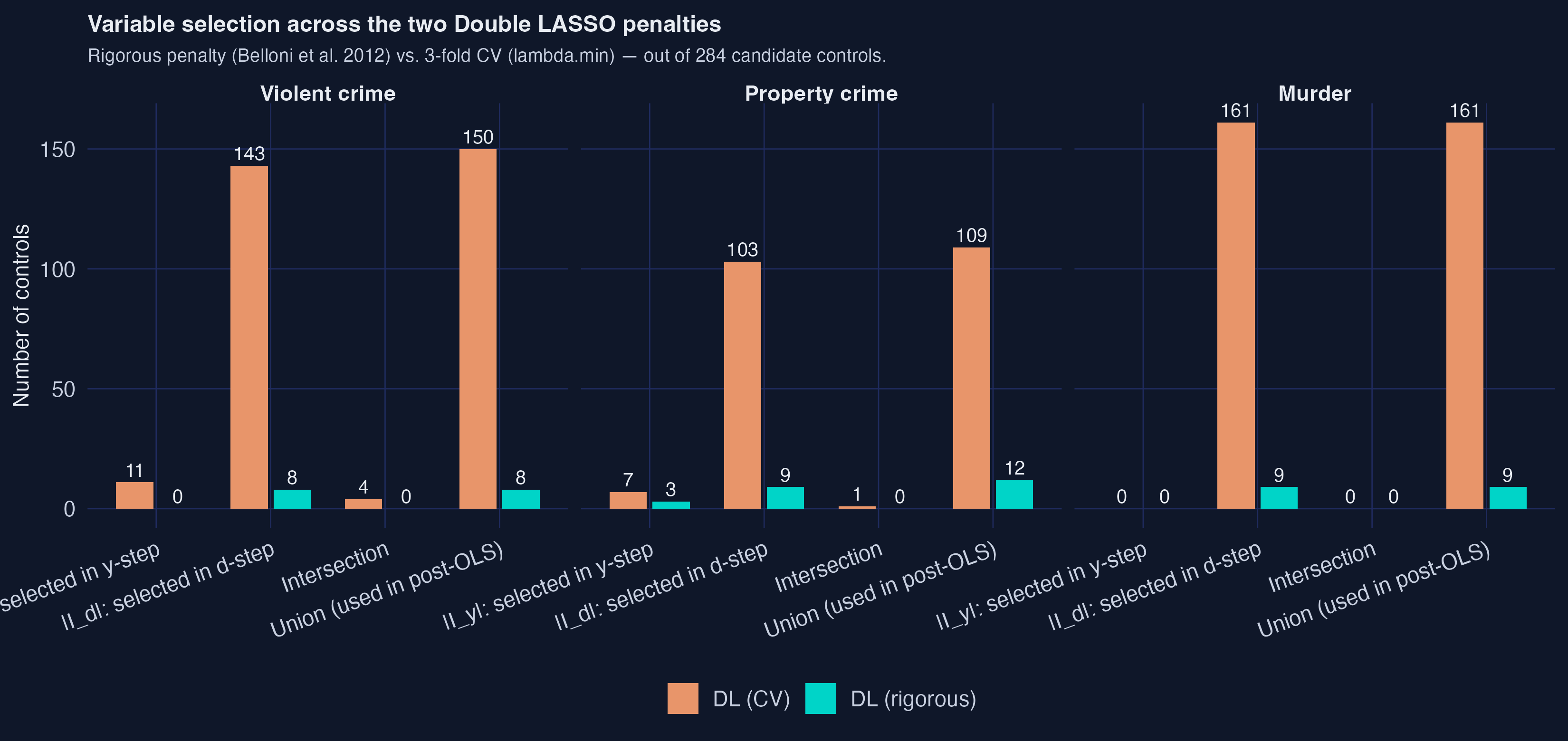
\(|I_y|\) , \(|I_d|\) , intersection, union out of 284 candidates — rigorous (teal) vs CV (orange).
The rigorous penalty under-selects on purpose; CV’s 20× larger union chases prediction, not the causal signal.
For violent crime the rigorous union is 8; the CV union is 150 — twenty times more. |I_y| = 0 for violent and murder: no control predicts crime well enough to survive the rigorous threshold, while |I_d| = 8–9 says abortion is predictable. That asymmetry is exactly when DL helps most.
Theory-tuned \(\lambda\) protects the causal signal; prediction-tuned \(\lambda\) flips it
Rigorous (theory)
\(\lambda\) from Belloni et al. theory8–12 controls kept
violent \(\hat\alpha = -0.096\)
selection matches the paper exactly
CV (prediction)
\(\lambda\) minimises prediction MSE109–161 controls kept
violent \(\hat\alpha = +0.019\) (sign flip)
murder \(\hat\alpha = -1.11\) (explodes)
Same three-step recipe, same data — only λ differs. CV optimises prediction, so it includes marginally-useful controls; cumulatively they soak up the treatment’s variation.
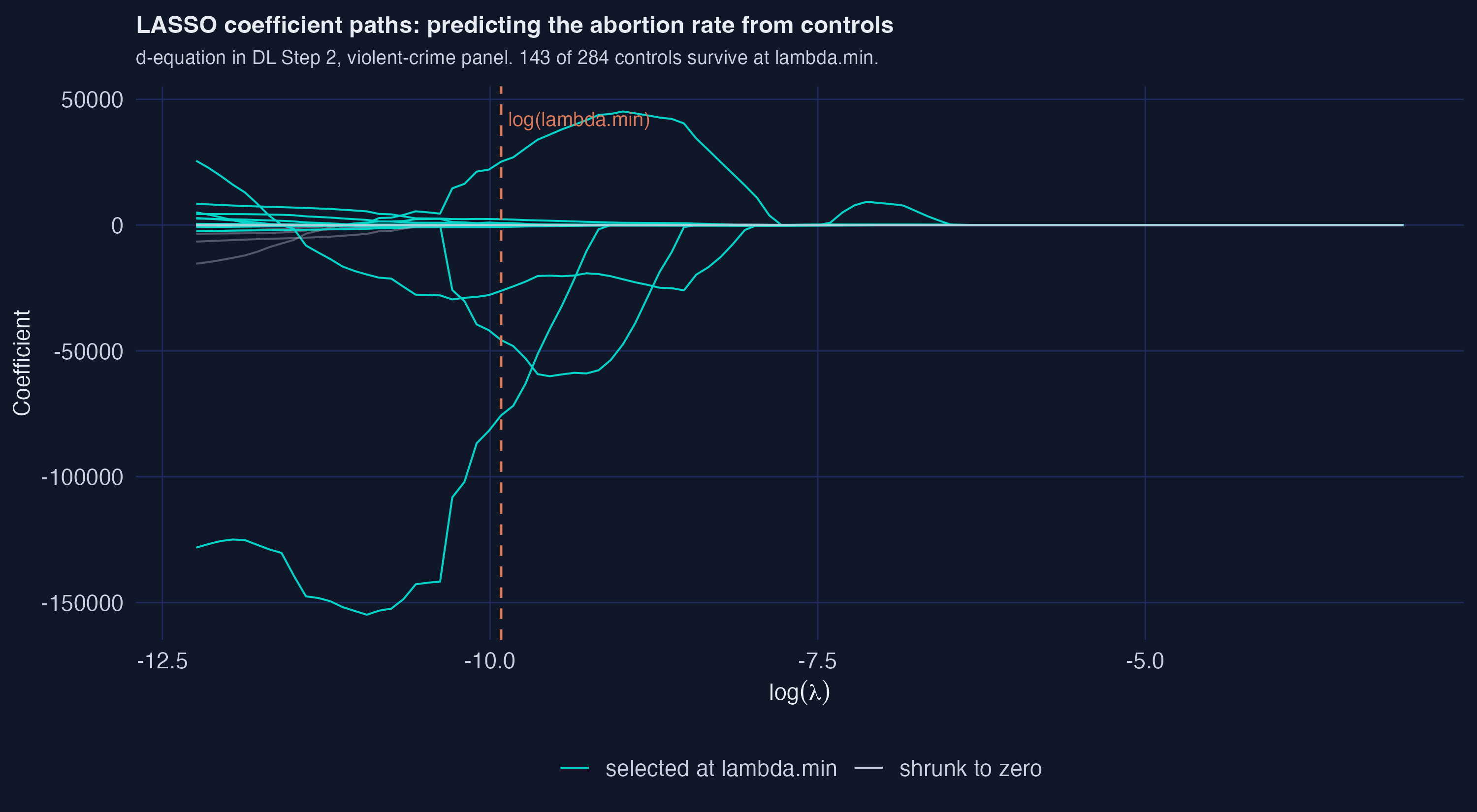
Cross-validation’s \(\lambda\) is so small that 143 of 284 controls survive
Coefficient paths, \(d\) -equation (violent panel). Dashed line = \(\log(\lambda_{\min})\) ; 143 paths nonzero there.
Prediction-optimal is not selection-optimal — the causal target doesn’t want these 143 controls.
Even in the treatment equation alone, CV’s MSE-optimal λ keeps 143 controls. Prediction-optimal is not selection-optimal for a causal target — the whole lesson in one picture.