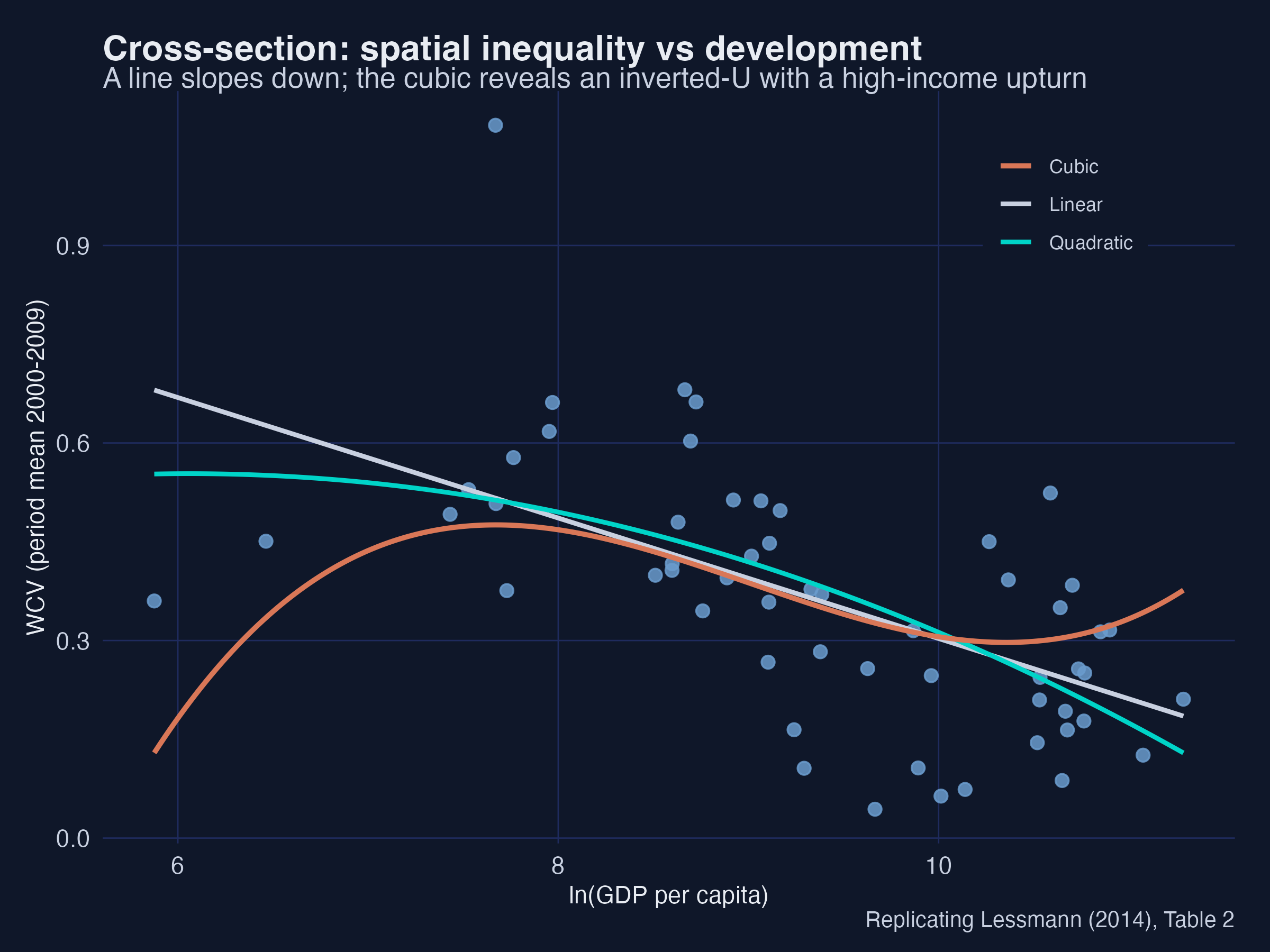
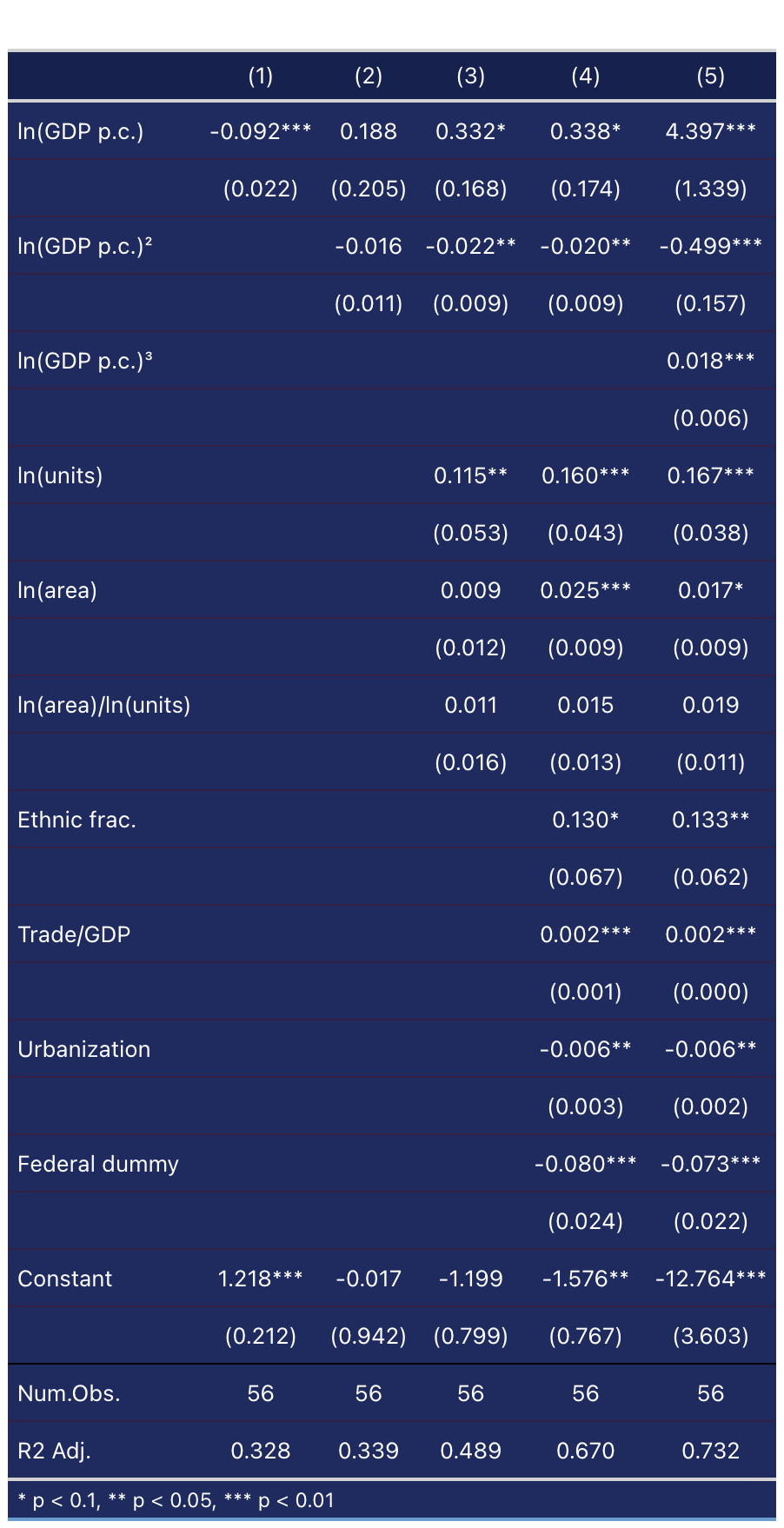
With controls the inverted-U appears (+0.34* / −0.02**); the cubic term adds the high-income upturn.
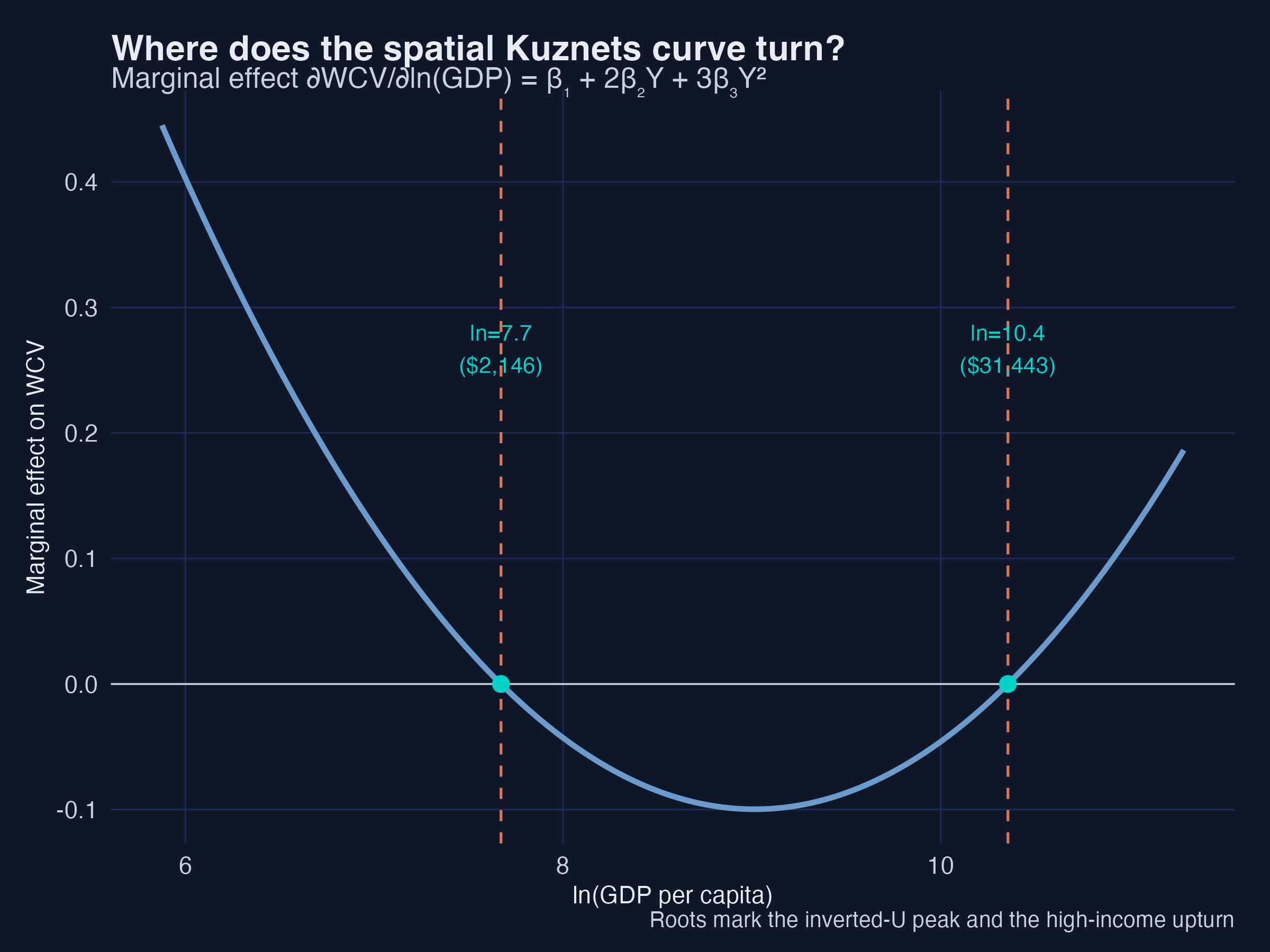
Where does the curve turn? Set the derivative to zero
Solving \(\partial \mathrm{WCV}/\partial \ln(\mathrm{GDP}) = \beta_1 + 2\beta_2 Y + 3\beta_3 Y^2 = 0\) gives a peak near $2,100 and a trough near $31,000.
Three phases: gaps widen up to $2,100, close until $31,000, then widen again.
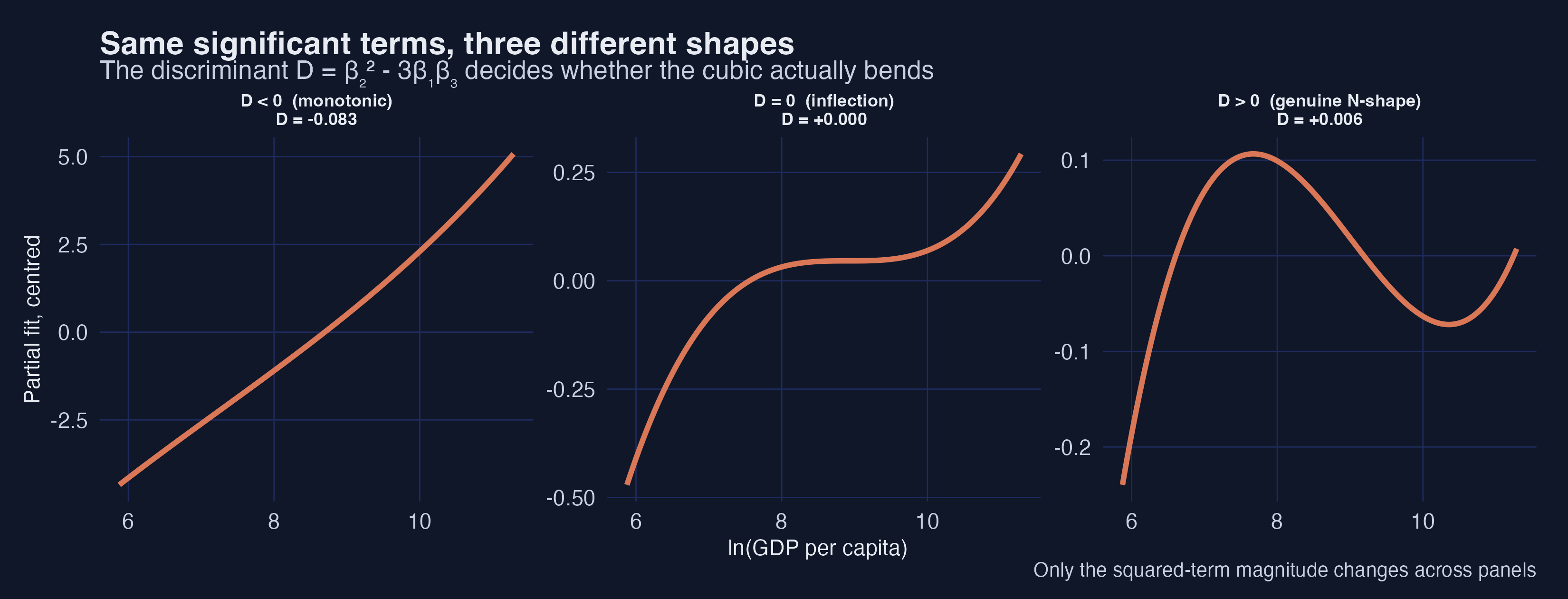
Significant ≠ a genuine bend — check the discriminant
The test: \(D=\beta_2^2-3\beta_1\beta_3\)
\(D>0\) → two turning points · \(D=0\) → inflection only · \(D<0\) → monotonic
Cross-section: \(D=+0.0055>0\), both turning points in range → genuine N-shape
Panel cubic: insignificant, and a turning point falls far outside the data → no within-country bend
Significance says keep the term; the discriminant says whether the curve bends.
The discriminant decides the shape
Same significant terms, three shapes — only the discriminant tells them apart.
One number — the sign of \(D\) — separates a cubic that bends from one that merely curves.
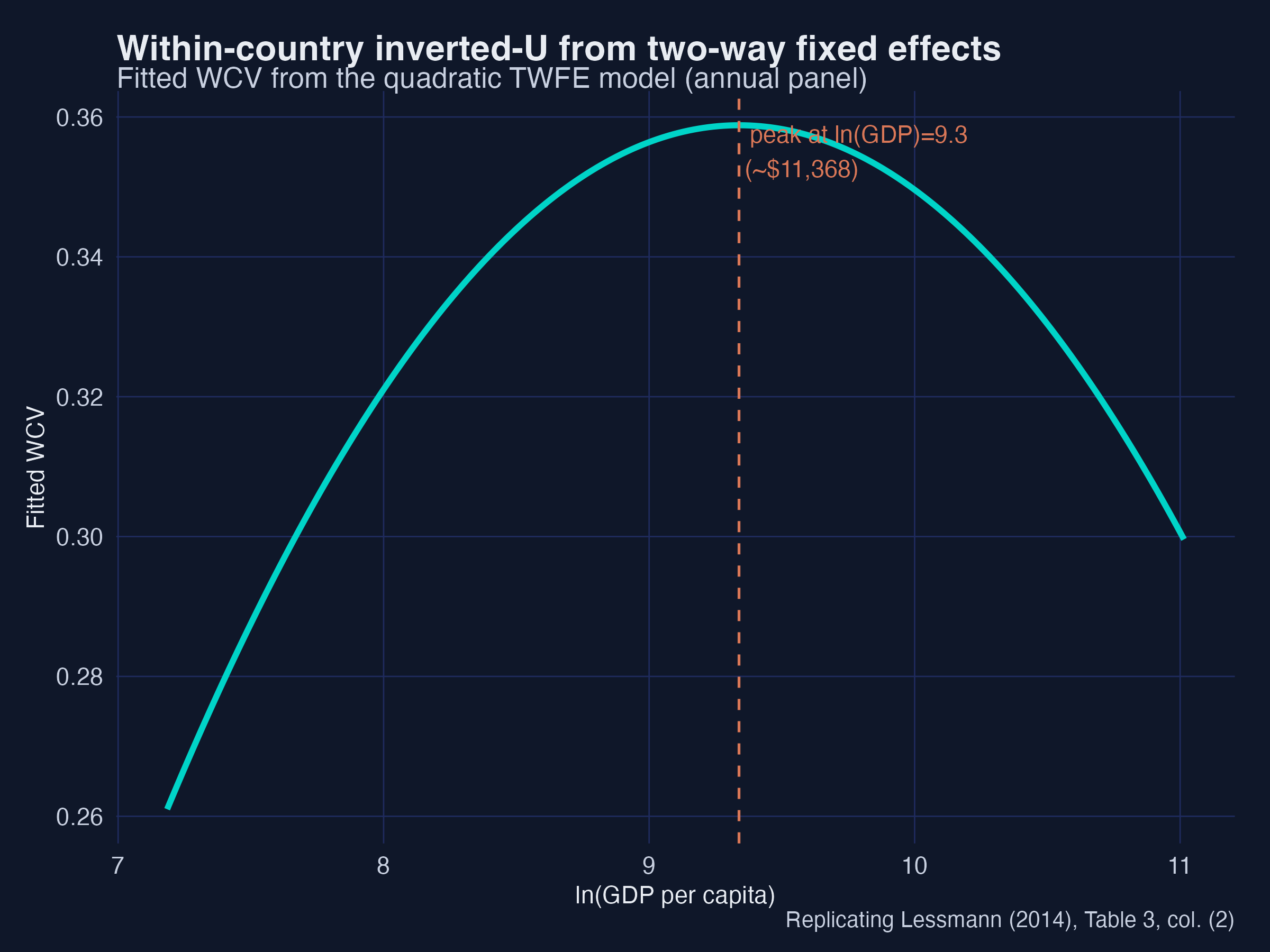
Fixed effects change the story, not just the standard errors
feols(wcv ~ lnGDP +I(lnGDP^2) + trade_gdp + urbanization | country + year, data = annual, vcov ="hetero")
Cubic term: insignificant — no within-country upturn
The upturn was a between-country artefact all along.
Within a country, inequality peaks near $18,000 and then falls
Fitted WCV from the TWFE quadratic, peaking near $18,000.
Past the peak, a country’s regional gaps start to close as it keeps growing.
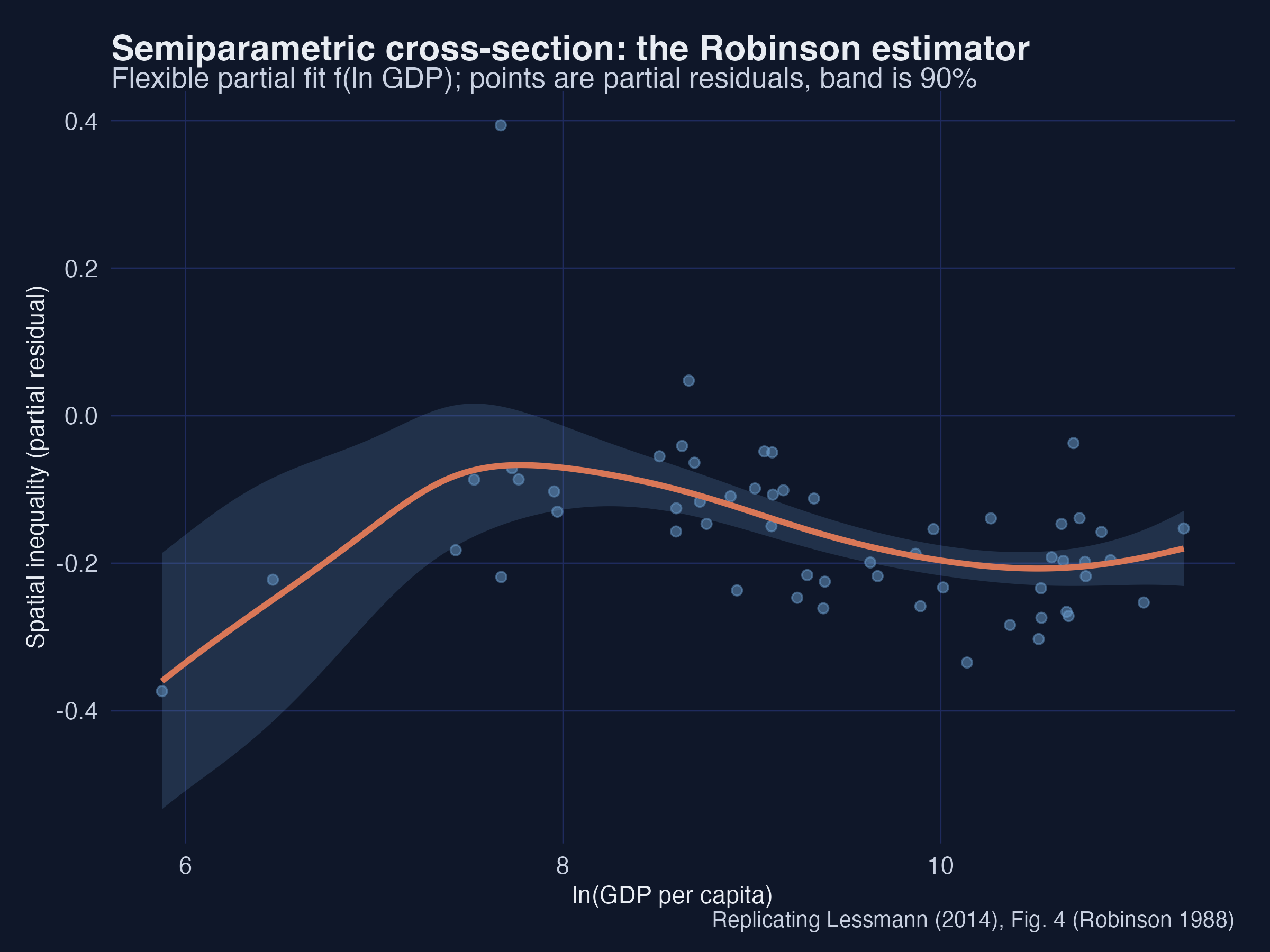
Semiparametric, no polynomial assumed — same shape
Robinson (1988) partial fit with a 90% band: inverted-U with a high-income upturn.
A curve that was never told to be a cubic traces the same shape.
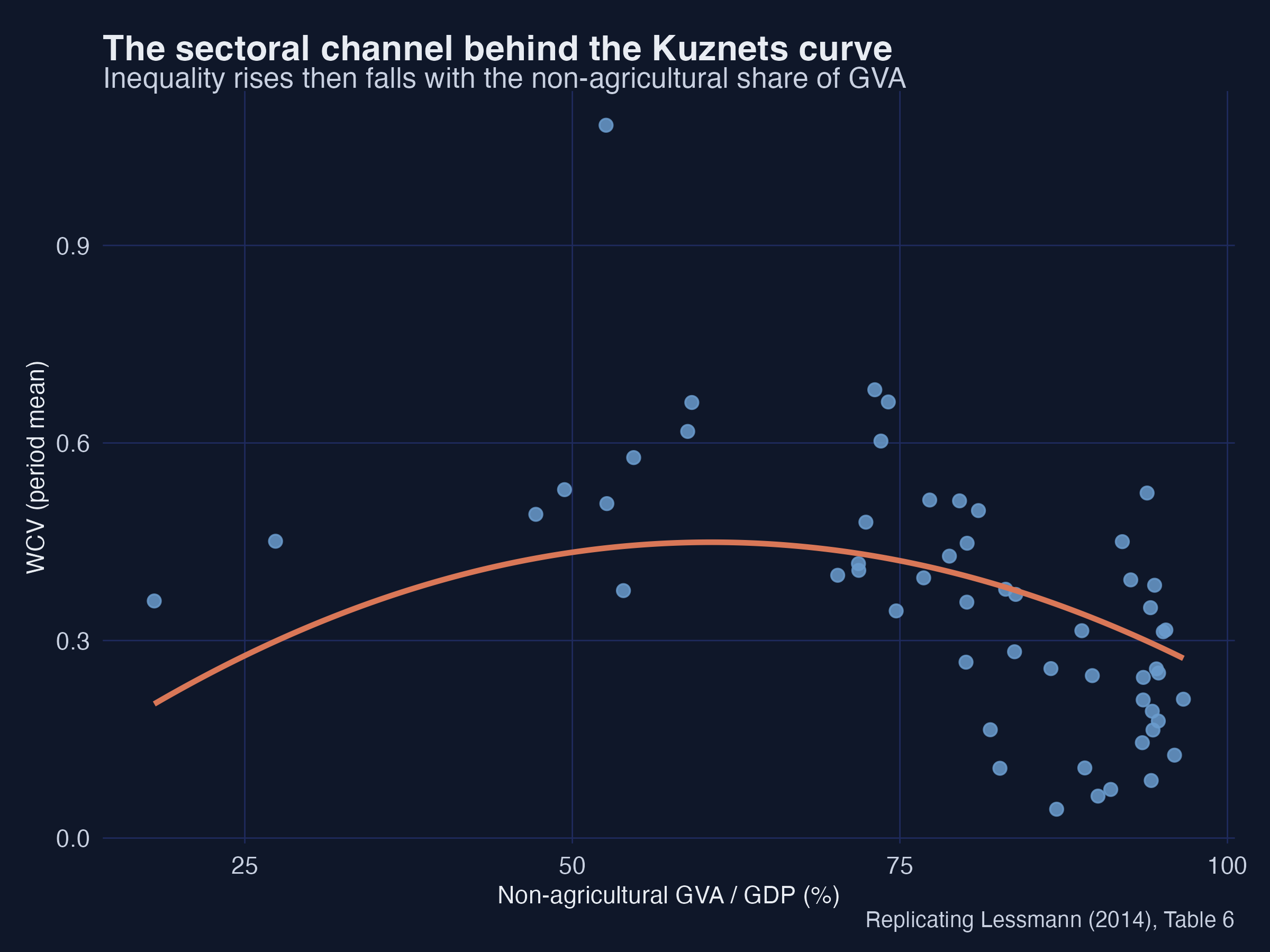
Structural change tracks the curve
Replace income with the non-agricultural share of output — the inverted-U returns.
Swap income for the non-agricultural share and the same inverted-U appears (+0.0165*** / −0.00014***).
The strongest objection — and the answer
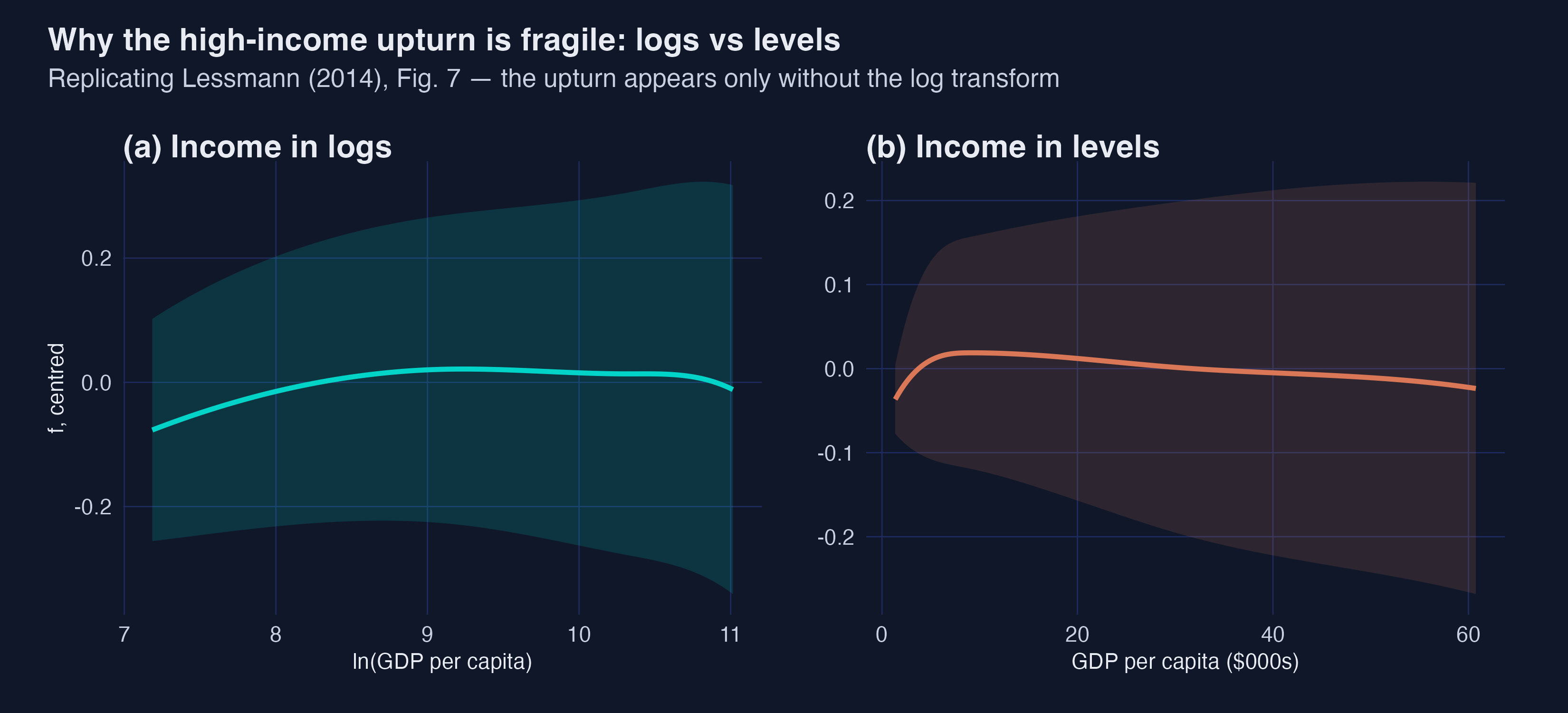
Objection. The high-income upturn is a measurement artefact — it shows up with income in levels and disappears in logs — and the data are synthetic anyway.
Response. Agreed on the upturn: we report it as fragile, not as a finding. The inverted-U itself survives logs, levels, fixed effects and both semiparametric estimators.
The Resolution
Act III
Four estimators agree on the inverted-U — and disagree only on the upturn
Inverted-U confirmed across cross-section OLS, panel TWFE, and two semiparametric estimators
Turning points at ~$2,100 and ~$31,000 of GDP per capita
The upturn is between-country, not within-country — fixed effects reveal it
All of it on synthetic data calibrated to Lessmann (2014) — a method demo, not new evidence.
The shape is robust; only the upturn depends on whether you look between or within countries.
The high-income upturn is real but fragile
It appears in income levels, vanishes in logs (and within countries).
Report the inverted-U with confidence; report the upturn with a caveat.
Wide regional gaps are a transitional stage of development — not a destination
The high-income upturn lives between countries, not within them.
Full tutorial, code, data and web app: carlos-mendez.org/post/r_kuznets