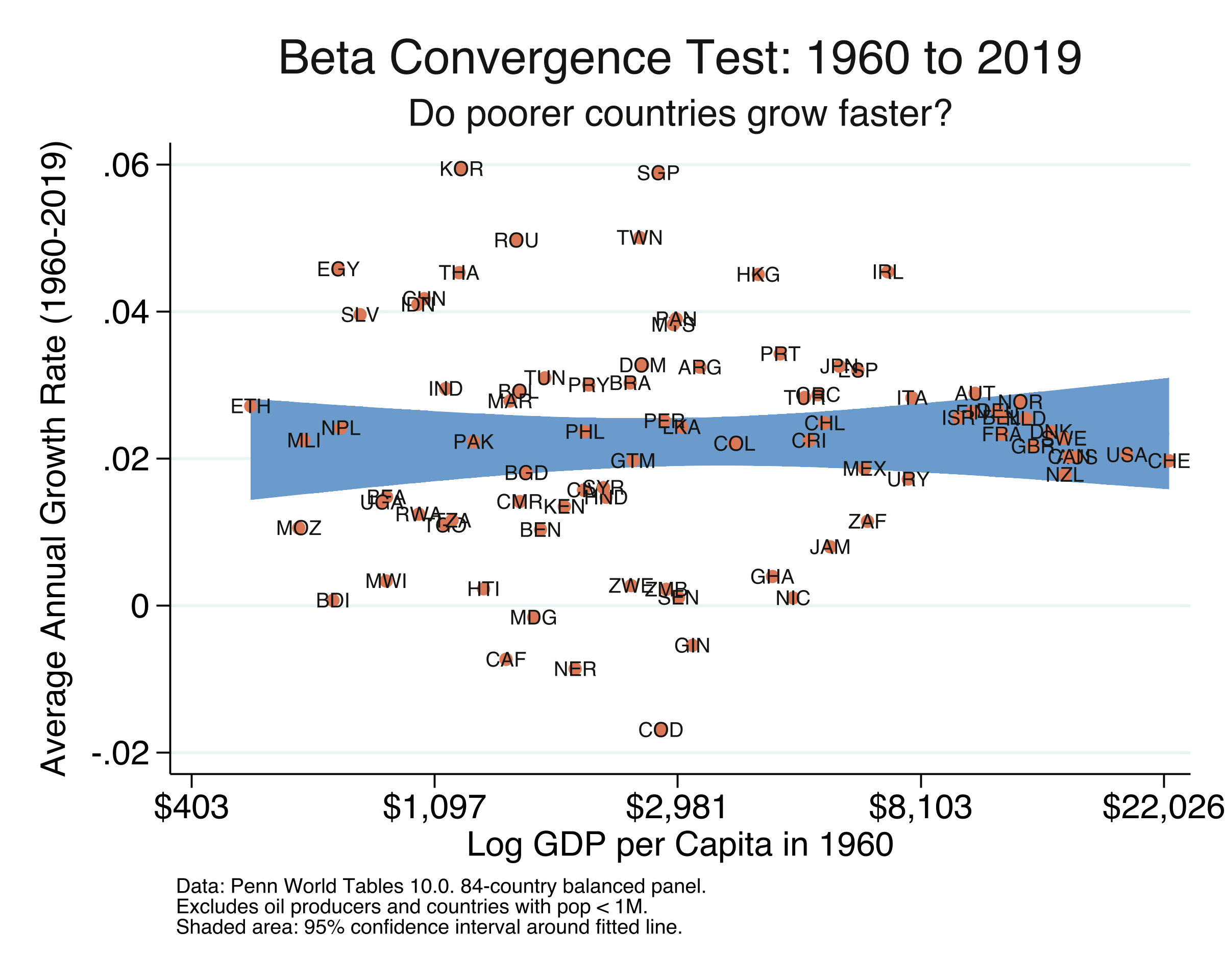
\(g_i\) is country \(i\)’s annualized growth; \(\ln(y_{i,0})\) is its log starting income. A negative\(\lambda\) means convergence — the poor grow faster.
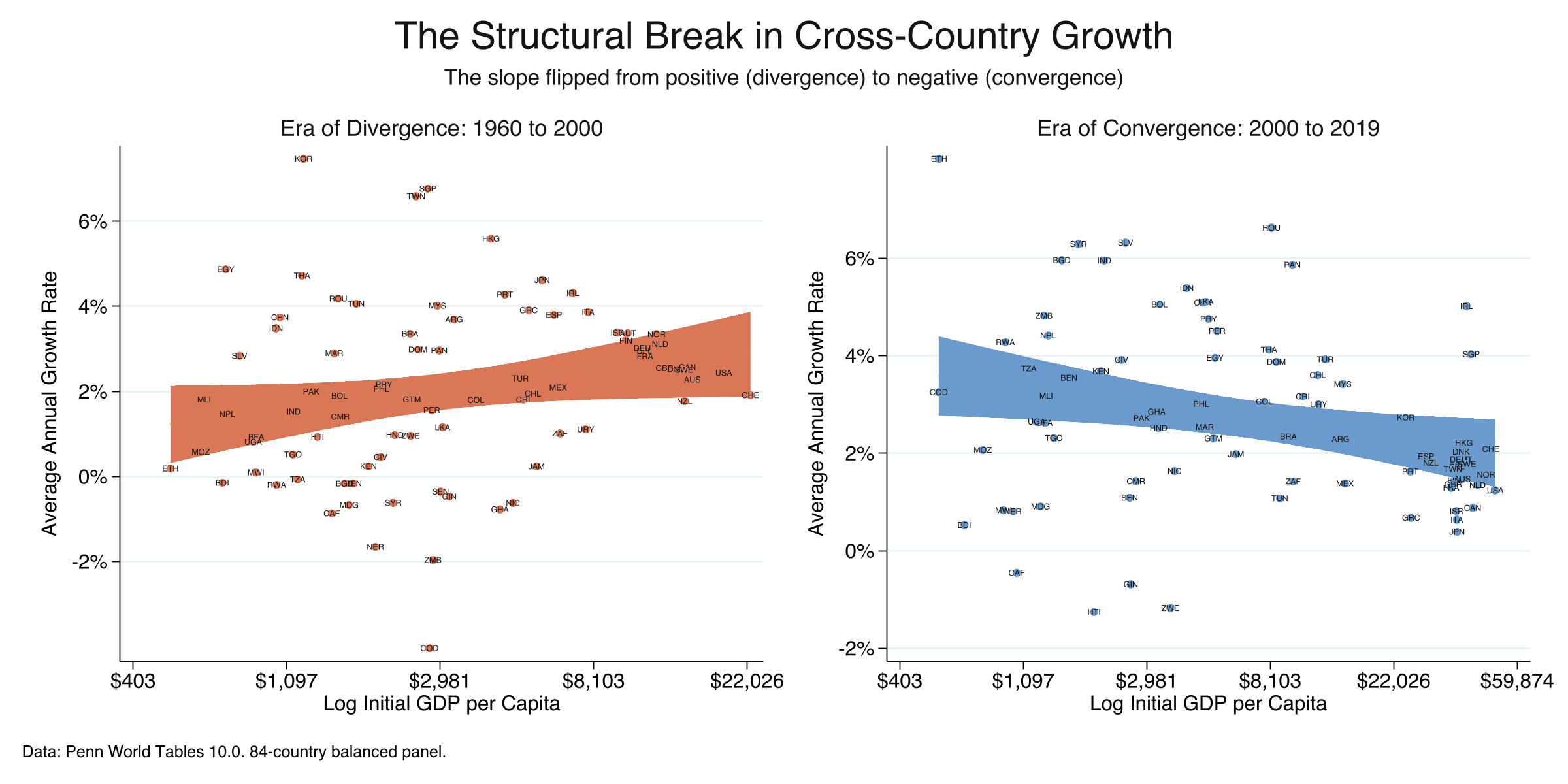
Split at 2000 and the flat line shatters into two opposite eras
Era of divergence (1960–2000, orange) versus era of convergence (2000–2019, steel): the slope flips sign.
Before 2000 the gap widened; after 2000 it began to close
Period
\(\lambda\)
p
Verdict
1960–2000
+0.00437
0.007
divergence
2000–2019
−0.00352
0.019
convergence
A total swing of 0.0079 — a complete reversal that the 60-year pooled regression silently averaged away.
A slope isn’t a speed — convert \(\lambda\) into the structural \(\beta\)
\(\lambda\) depends on the window length \(s\); the Barro–Sala-i-Martin speed\(\beta\) does not. The half-life\(\tau\) is the years to close half the gap.
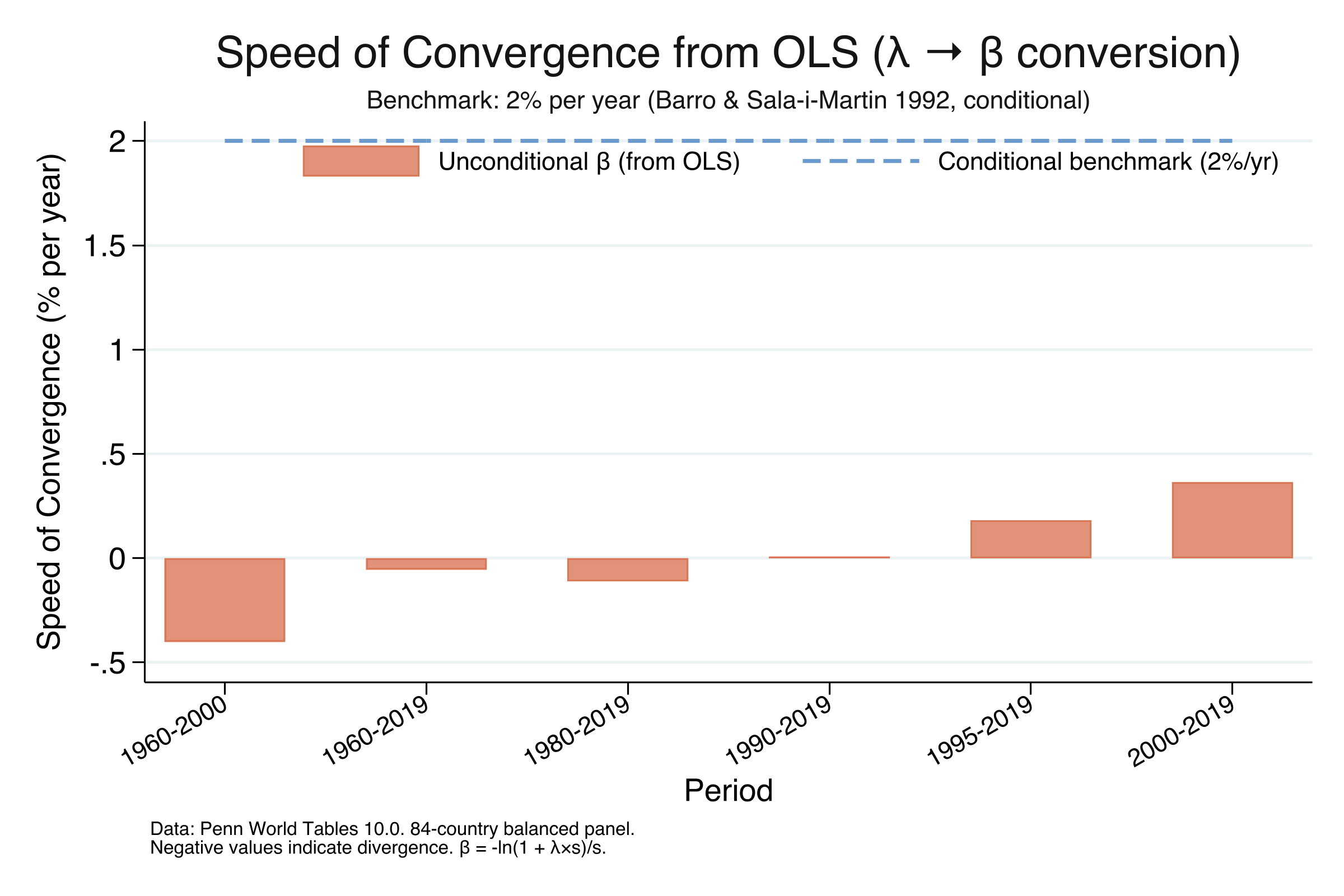
Convergence since 2000 runs at 0.36% a year — five times slower than the benchmark
Speed of unconditional convergence (β) across six windows; dashed line = the classic 2% conditional benchmark.
The number that should temper optimism: a 190-year half-life
190 years
to close half the income gap at the 2000–2019 speed (\(\beta = 0.00365\))
Why not estimate \(\beta\) directly? The trouble is it hides inside an exponential
OLS needs parameters to enter linearly. Here \(\beta\) is trapped in \(e^{-\beta s}\) — so OLS can only recover the whole blob \(\lambda\), then we back out \(\beta\).
Stata’s nl estimates \(\beta\) in one line — start it at the 2% benchmark
{b1=0.02} is \(\beta\) with the 2% benchmark as its starting guess; the iterative solver then minimises squared residuals.
OLS-then-convert and direct NLS agree to seventeen decimal places
Period
OLS → \(\beta\)
NLS \(\beta\)
difference
2000–2019
+0.00365
+0.00365
\(10^{-17}\)
1995–2019
+0.00182
+0.00182
\(10^{-17}\)
1960–2000
−0.00402
−0.00402
\(10^{-16}\)
The Barro–Sala-i-Martin equation is a reparameterization of the linear model — so the two routes must coincide.
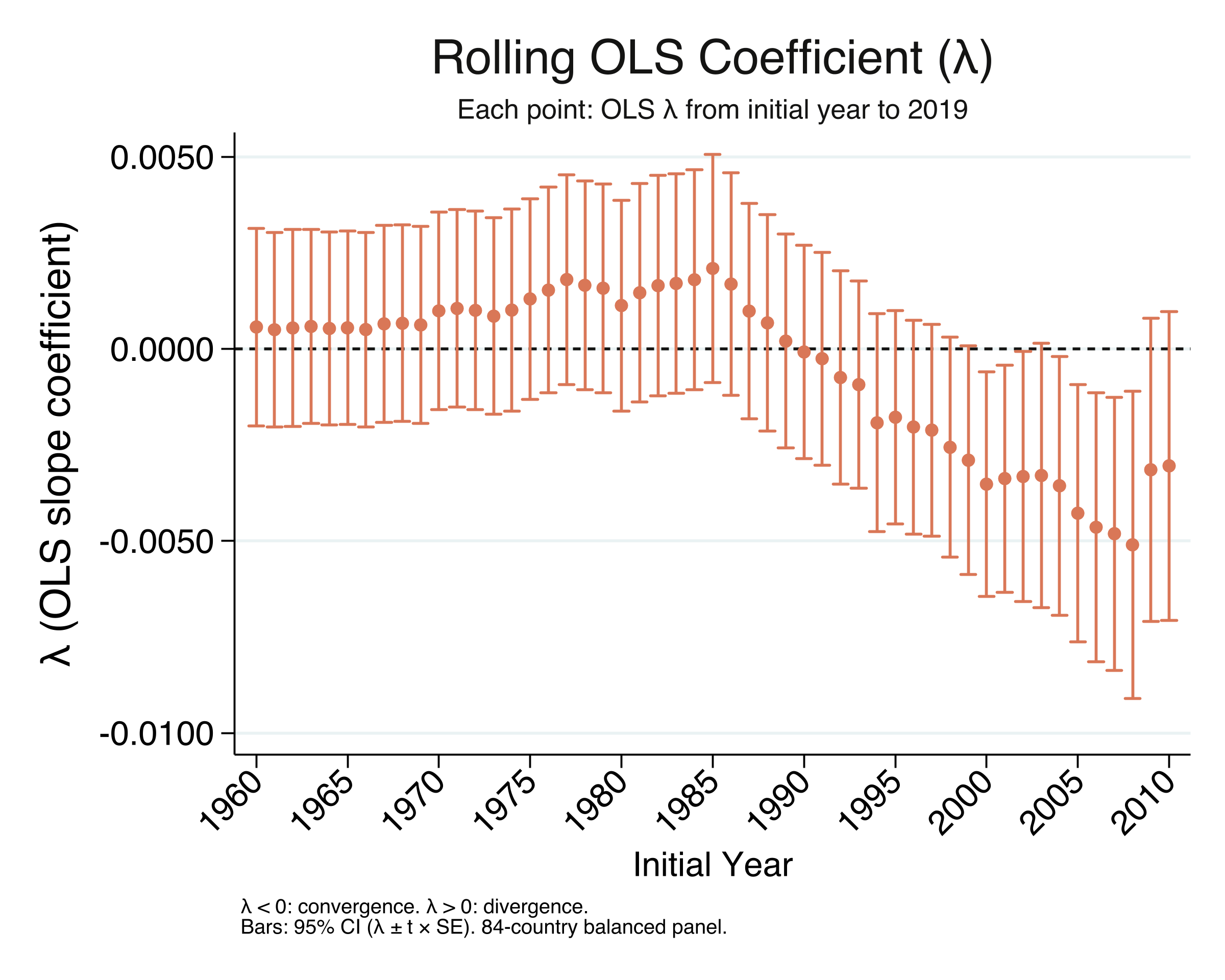
Watch convergence switch on: the rolling slope crosses zero around 1990
Rolling OLS \(\lambda\) from each start year to 2019, with 95% confidence intervals. Negative \(\lambda\) = convergence.
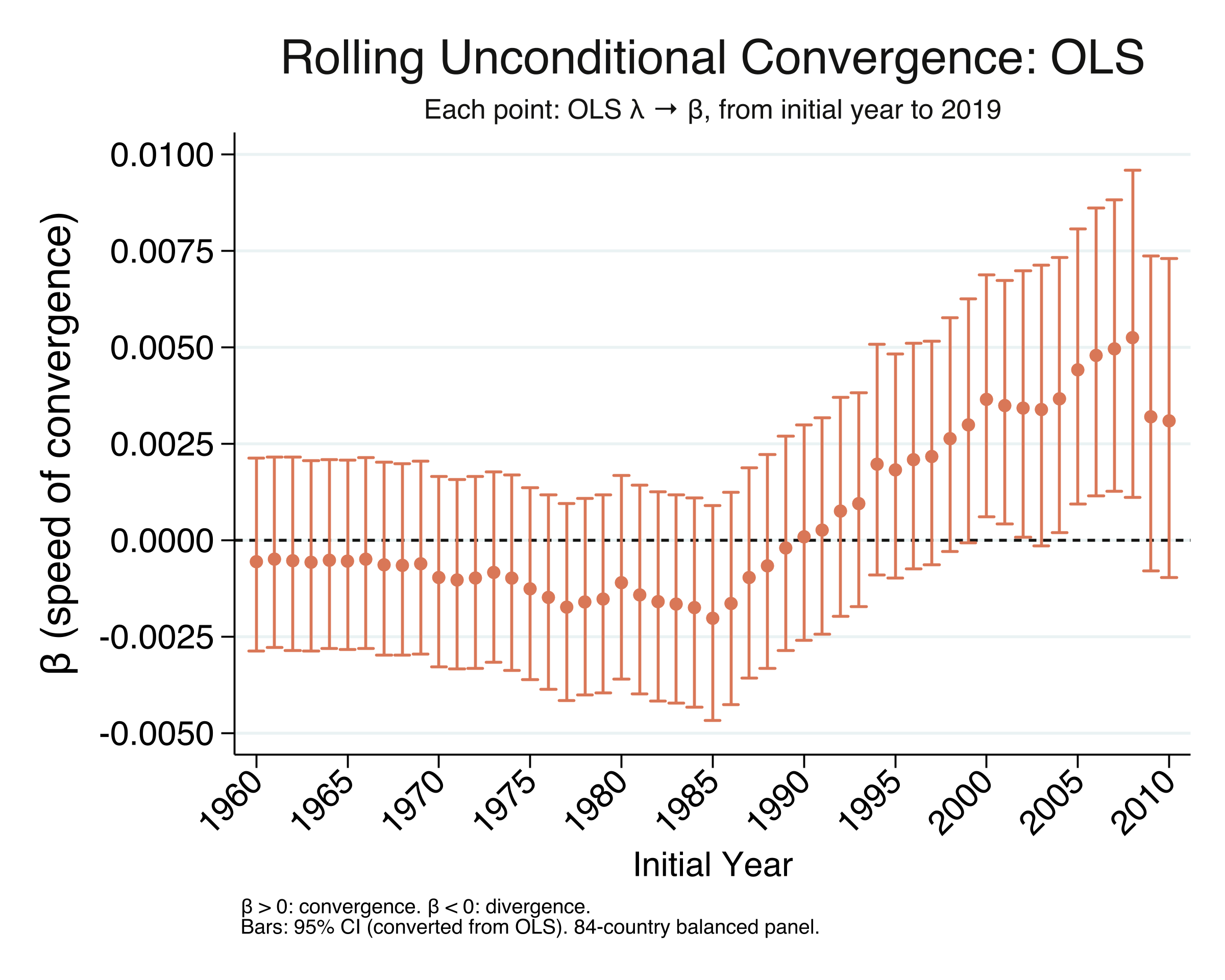
As \(\beta\), the same story peaks near 2005 then eases — the crisis footprint
Rolling structural \(\beta\) (OLS conversion; NLS is identical) from each start year to 2019, with 95% CIs.
The Resolution
Act III
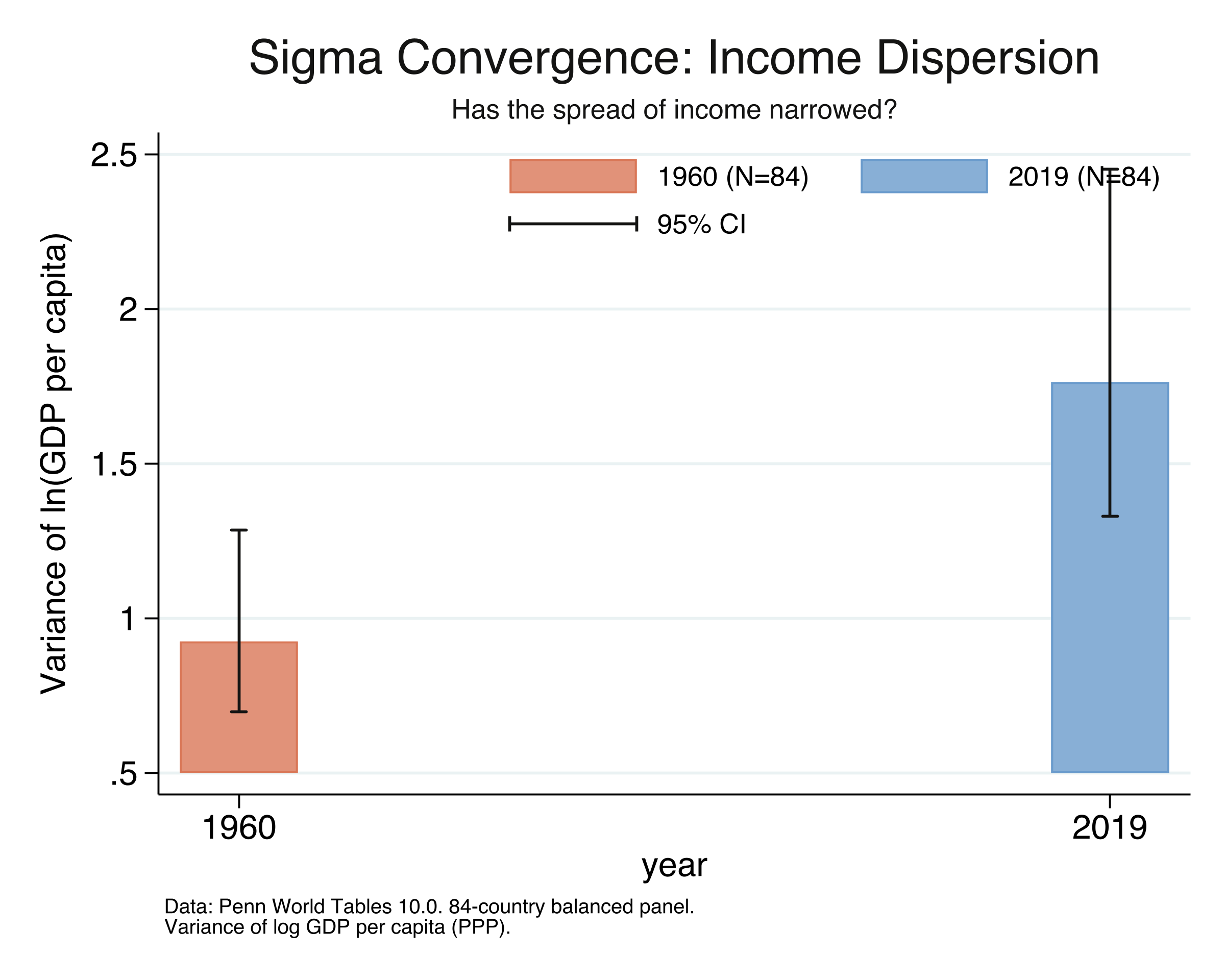
Beta convergence is real — yet the income spread grew by 91%
Variance of log GDP per capita, 1960 versus 2019 (same 84 countries), with chi-squared 95% CIs.
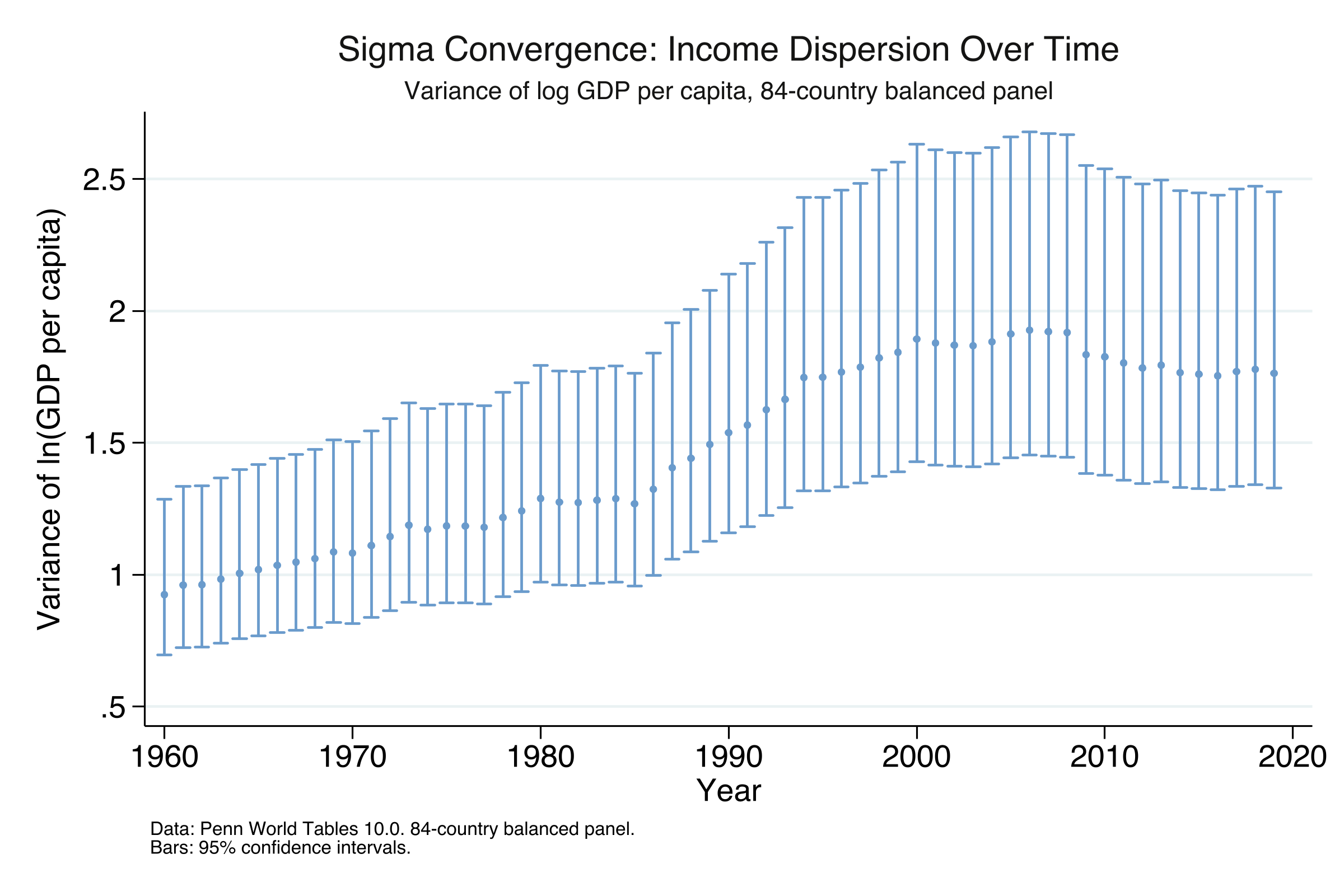
Sigma followed beta with an 8-year lag — and only after 2008
Year-by-year variance of log income (84-country panel). It peaks in 2008, then declines.
Can poor countries grow faster and the gap widen? Yes — that’s the whole point
Objection. Surely faster growth at the bottom must shrink the spread — this looks like a contradiction.
Response. No. Beta convergence is the average tendency; sigma is the realized spread. Random shocks can widen the distribution even while the rear runners accelerate. Beta is necessary but not sufficient for sigma — exactly what 1960–2008 shows.
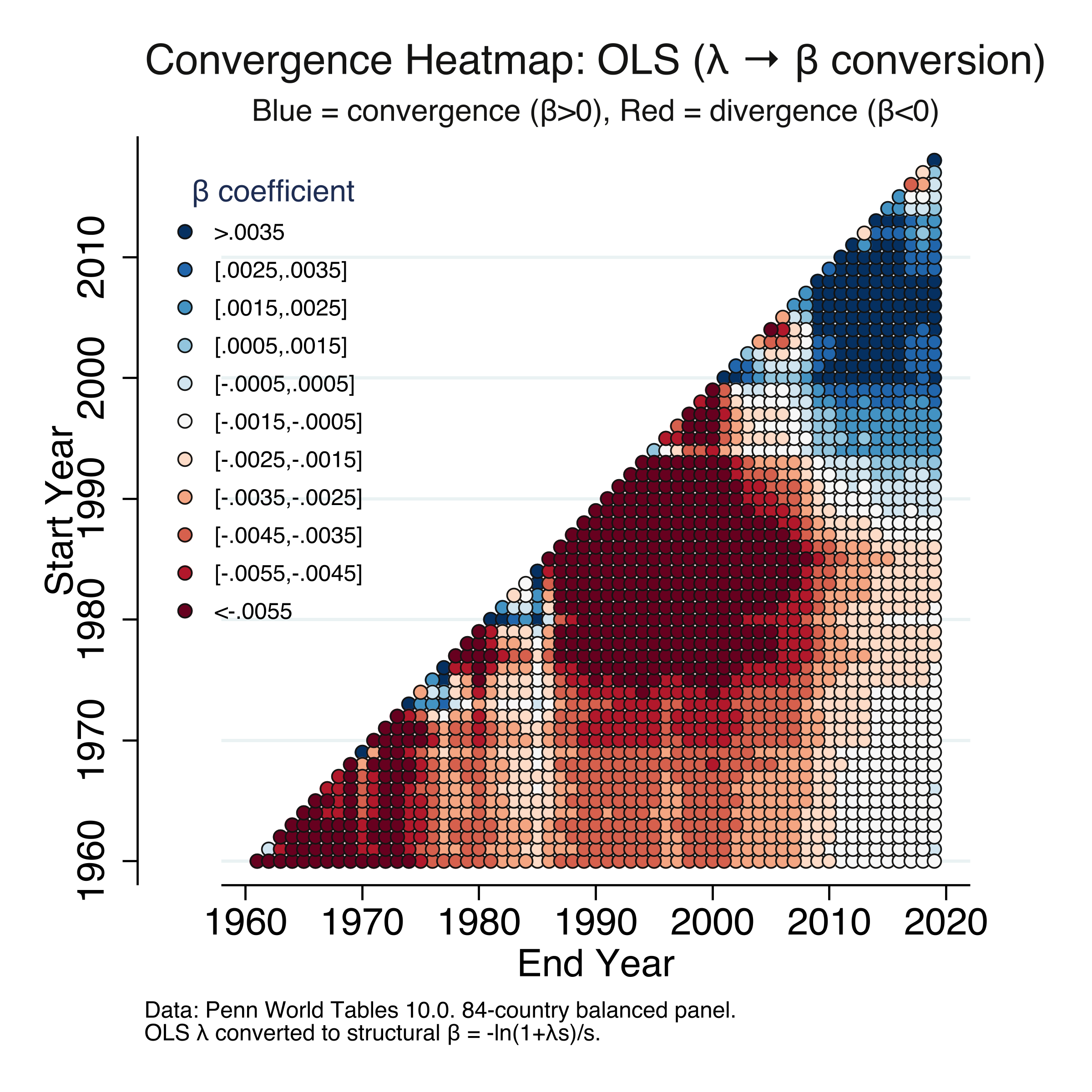
Robust across every window: red divergence before 2000, blue convergence after
Convergence heatmap over all start/end-year pairs (OLS β; the NLS heatmap is virtually identical). Blue = convergence, red = divergence.
This is an association, not a causal effect — two assumptions still do the work
Objection. Does a negative slope prove that being poor causes faster growth?
Response. No. This is unconditional convergence — a descriptive association across countries, not an ATE. A causal reading needs controls for institutions, human capital, and policy; the regression deliberately omits them.
What it means: convergence is real, but far too slow to wait out
Unconditional convergence is real since ~2000 — but at 0.36%/yr, a 190-year half-life
Five times slower than the 2% conditional benchmark
The 2019 income spread is still 91% wider than 1960’s
Catch-up forces alone won’t close global gaps in any planning horizon
Let theory, not patience, close the gap — convergence is real, but glacially slow.