IV Estimation with Panel Data

Economic shocks and civil conflict across 5,689 African regions

−0.2962SLS effect of lights on conflict
0.001OLS estimate · attenuated to zero
40.3first-stage F · instruments are strong

Carlos Mendez

Nagoya University (GSID)

June 11, 2026

The Tension

Act I

Does poverty cause violence? Regress conflict on income and you get nothing

Poor regions see more conflict — but correlation is not causation.

So we regress conflict on economic activity — and the slope is 0.001, indistinguishable from zero. Is the effect real, or is the measurement broken?

OLS says zero; 2SLS says −0.30 — same data, a 300-fold gap
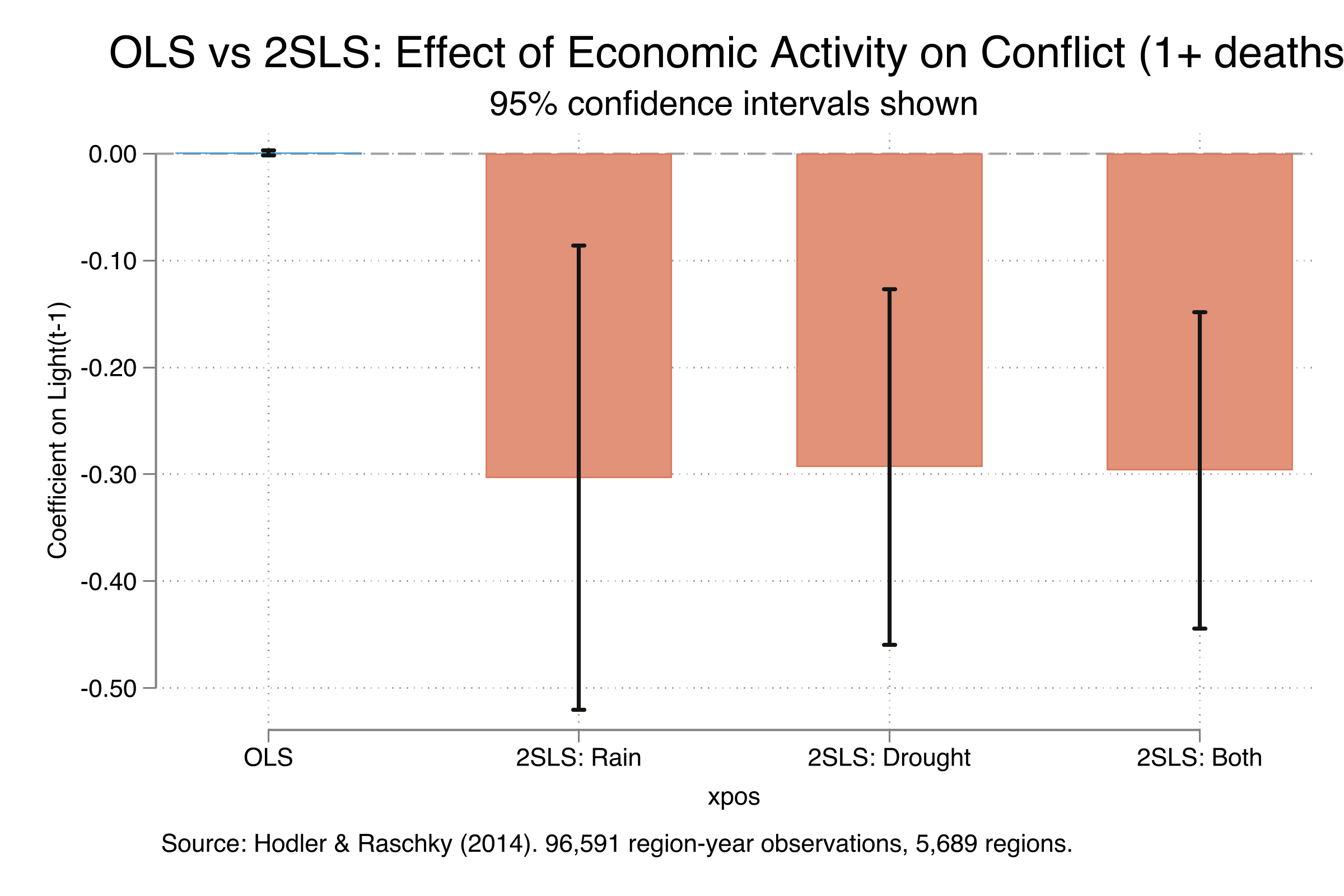
OLS coefficient (steel) is indistinguishable from zero; all three 2SLS estimates (orange) cluster around −0.30 with CIs far from zero.

Where we’re going

  • The endogeneity problem: why OLS is the wrong thermometer
  • The instrument: lagged weather as exogenous variation in income
  • The first stage: do the instruments actually move economic activity?
  • 2SLS, the LATE it identifies, and the diagnostics that license it

The Investigation

Act II

Three threats make the OLS slope uninterpretable

  • Omitted variables — institutions, geography, ethnic fractionalization drive both income and conflict
  • Reverse causality — conflict destroys infrastructure, so conflict lowers lights
  • Measurement error — nighttime lights \(\neq\) true GDP, biasing the slope toward zero

The instrumental-variables strategy attacks all three at once — if we can find an exogenous source of variation in economic activity.

The lab: 96,591 region-years, 5,689 regions, 53 countries, 1994–2010

  • Outcome — binary conflict in a region-year (1+ deaths; also a 25+ deaths version)
  • Endogenous regressor — lagged log nighttime light intensity (the income proxy)
  • Instruments — lagged log rainfall and lagged drought (Palmer index), two years prior

Region effects, region trends, and year effects are pre-absorbed. SEs clustered on 5,689 regions.

Weather two years back drives income, then income drives conflict

The identification rests on a lag chain. Weather at \(t-2\) shifts agricultural output and hence economic activity (lights) at \(t-1\), which then shifts conflict at \(t\).

First stage

\[Light_{i,t-1} = \tilde\delta\, Weather_{i,t-2} + \tilde\alpha_i + \tilde\beta_i t + \tilde\gamma_t + \tilde\varepsilon_{it}\]

Weather predicts income — relevance.

Exclusion

\[Weather_{i,t-2} \not\to Conflict_{i,t}\ \text{(directly)}\]

Weather two years back touches today’s conflict only through income.

The structural equation: \(\delta\) is the causal effect we want

\[Conflict_{it} = \delta\, Light_{i,t-1} + \alpha_i + \beta_i t + \gamma_t + \varepsilon_{it}\]

\(\alpha_i\) are region fixed effects, \(\beta_i t\) region-specific trends, \(\gamma_t\) year effects. The parameter \(\delta\) is the causal effect of economic activity on conflict probability.

2SLS identifies a LATE — the effect for weather-driven compliers

Estimand. Not the average effect over all regions. 2SLS recovers the Local Average Treatment Effect (LATE): the effect for the compliers — regions whose economic activity actually responds to weather variation.

Why it can exceed the ATE. Compliers are the more agriculturally exposed regions. Their conflict may be more income-sensitive — but since most African regions are heavily agricultural, the LATE–ATE gap is likely small.

Two stages: fit lights from weather, then conflict from fitted lights

xtset objectid year
xtivreg2 ucdp_death_dummy_dt ///
    (llnlight01_dt = l2lnrain01_dt l2meanpdsi_dt) Iyear*, ///
    fe robust cluster(objectid) first
* `first` prints the first-stage F; the parentheses mark the endogenous regressor.

Rainfall moves economic activity: a clean positive first stage
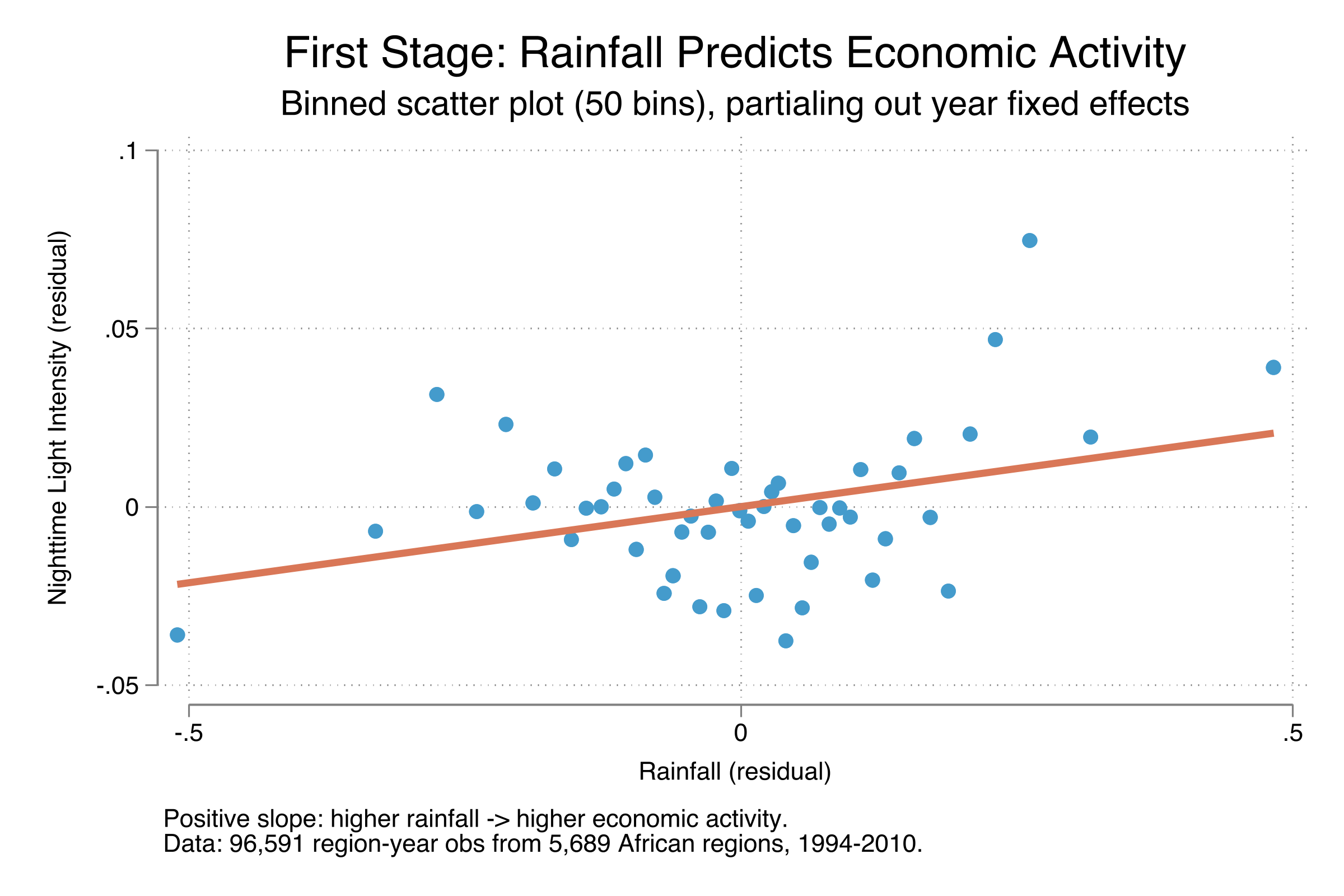
Binned scatter (50 bins) of rainfall residuals vs nightlight residuals, year effects partialled out — a clear upward slope.

Drought is the stronger instrument — a tighter first stage
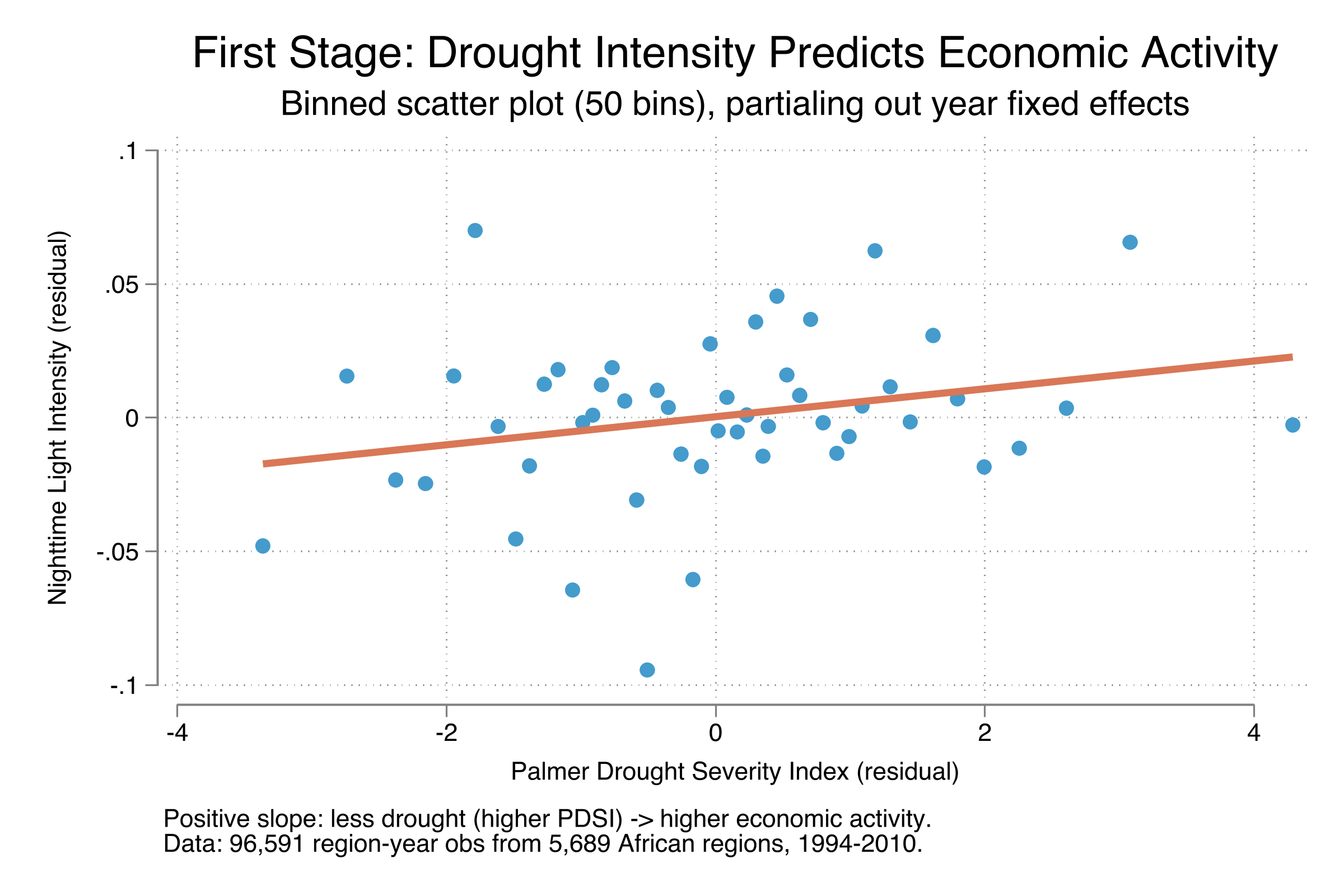
Binned scatter of drought (PDSI) residuals vs nightlight residuals — less drought predicts more economic activity, with a tighter fit than rainfall.

Both weather instruments move conflict in the reduced form — the IV numerator is real
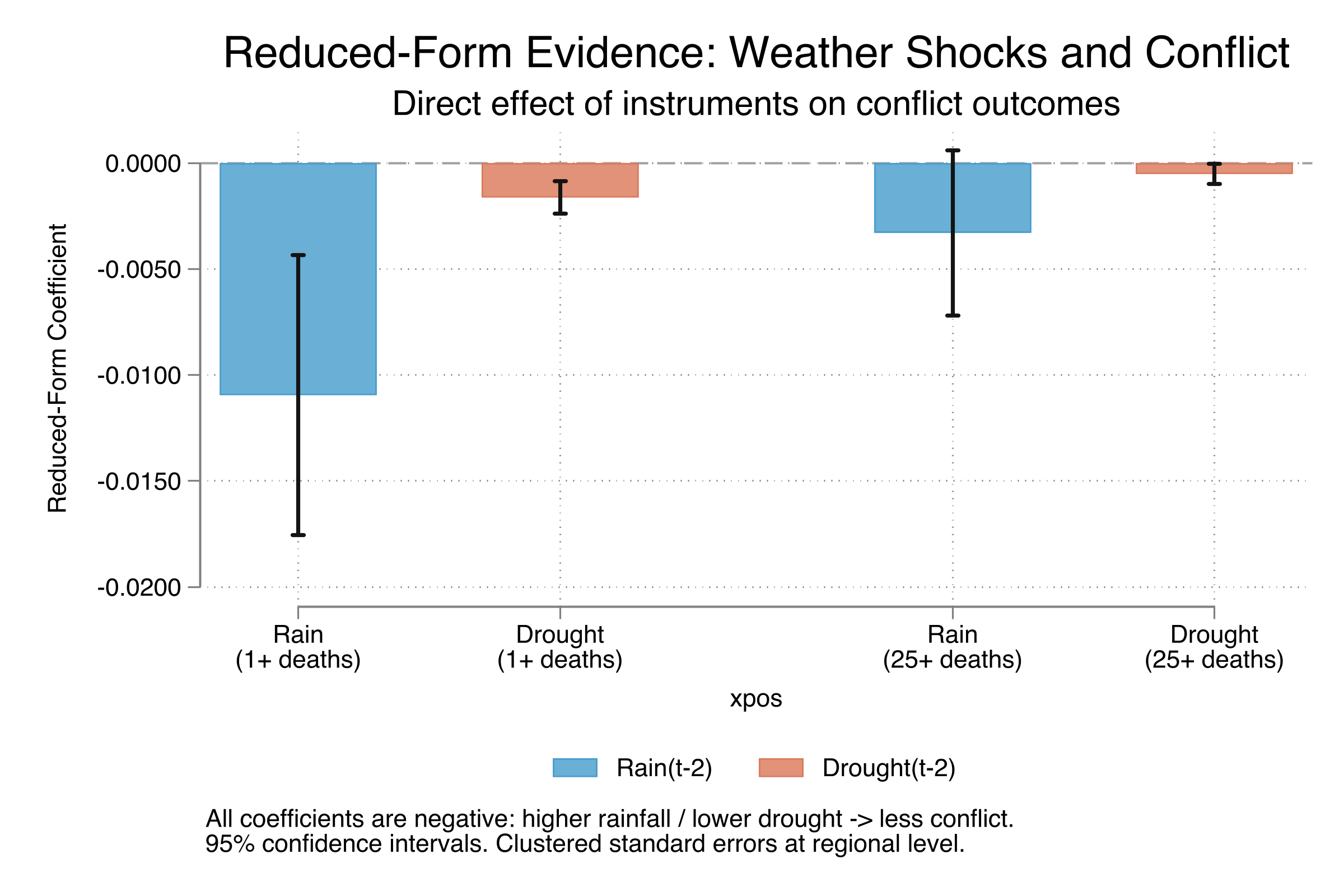
Reduced-form coefficients (weather → conflict): more rain and less drought both predict less future conflict, for both outcomes.

Conflict is rare and declining — context for a binary outcome
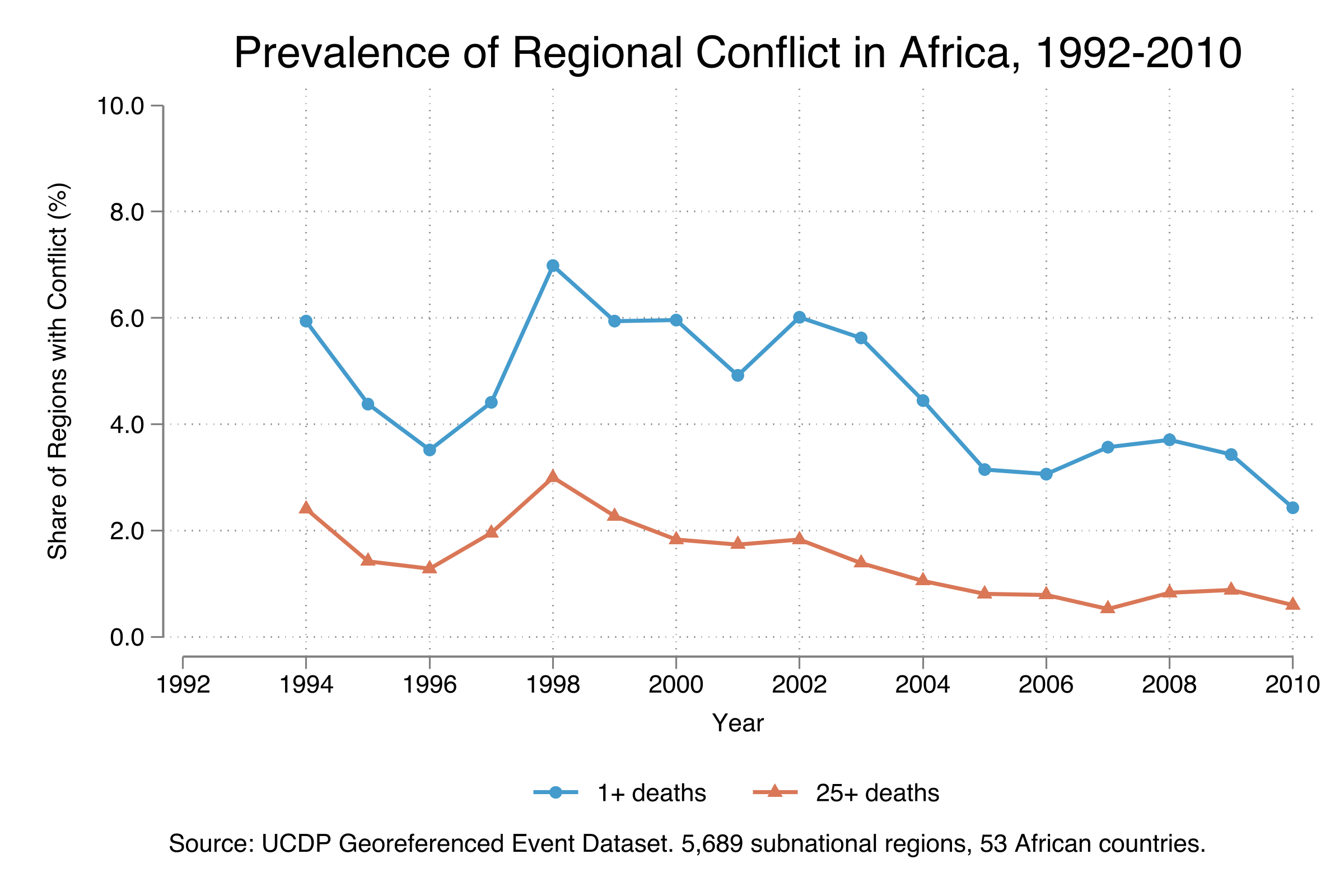
Conflict prevalence by year: any-death conflict (steel) peaks near 7% in 1998 then falls to ~2.5%; severe 25+ death conflict (orange) tracks below at one-third the rate.

The Resolution

Act III

Throw out the instruments and OLS reads exactly zero

0.001

OLS coefficient on lights (SE 0.001, p = 0.50) — attenuated to nothing by measurement error

Instrument the lights and the effect snaps to −0.296

−0.296

2SLS, both instruments (SE 0.076, p < 0.01) — roughly 300-fold the OLS magnitude, opposite sign

Three instrument choices, one answer: −0.293 to −0.303

Instrument \(\hat\delta_{2SLS}\) SE Sig. 1%?
Rain(\(t-2\)) −0.303 0.111 yes
Drought(\(t-2\)) −0.293 0.085 yes
Both −0.296 0.076 yes

The estimate barely moves across instruments — strong evidence the causal finding is robust, not an artifact of one weather variable.

A 10% income drop raises conflict risk by 3 points — a 66% jump

A 10% fall in nighttime lights (\(\approx 0.1\) log units) raises the probability of any-death conflict by about 3 percentage points.

Against a 4.6% baseline, that is a 66% increase in conflict risk — from 4.6% to roughly 7.6% in an average region. For severe (25+ death) conflict the effect is about one-third as large.

Strong and valid: every diagnostic clears its threshold

Test Statistic Threshold Verdict
First-stage F (Rain) 24.62 > 16.38 strong
First-stage F (Drought) 40.33 > 16.38 strong
Hansen \(J\) (overid) \(p = 0.93\) \(p > 0.10\) valid

Both instruments clear Stock–Yogo by a wide margin; the overid test says they tell the same story.

Does IV manufacture causality? No — two assumptions still carry the weight

Objection. Weather instruments don’t prove income causes conflict; you’ve just assumed exclusion.

Response. Correct — identification rests on relevance (testable: F = 24–40) and exclusion (untestable for a single instrument). The two-year lag makes a direct weather→conflict channel implausible, and the Hansen \(J\) shows the two instruments agree. IV disciplines the estimate; it cannot relax the identifying assumptions.

When measurement is noisy, the instrument — not OLS — tells the truth.