Smokers’ babies weigh 275 g less — but is that smoking, or who smokes?
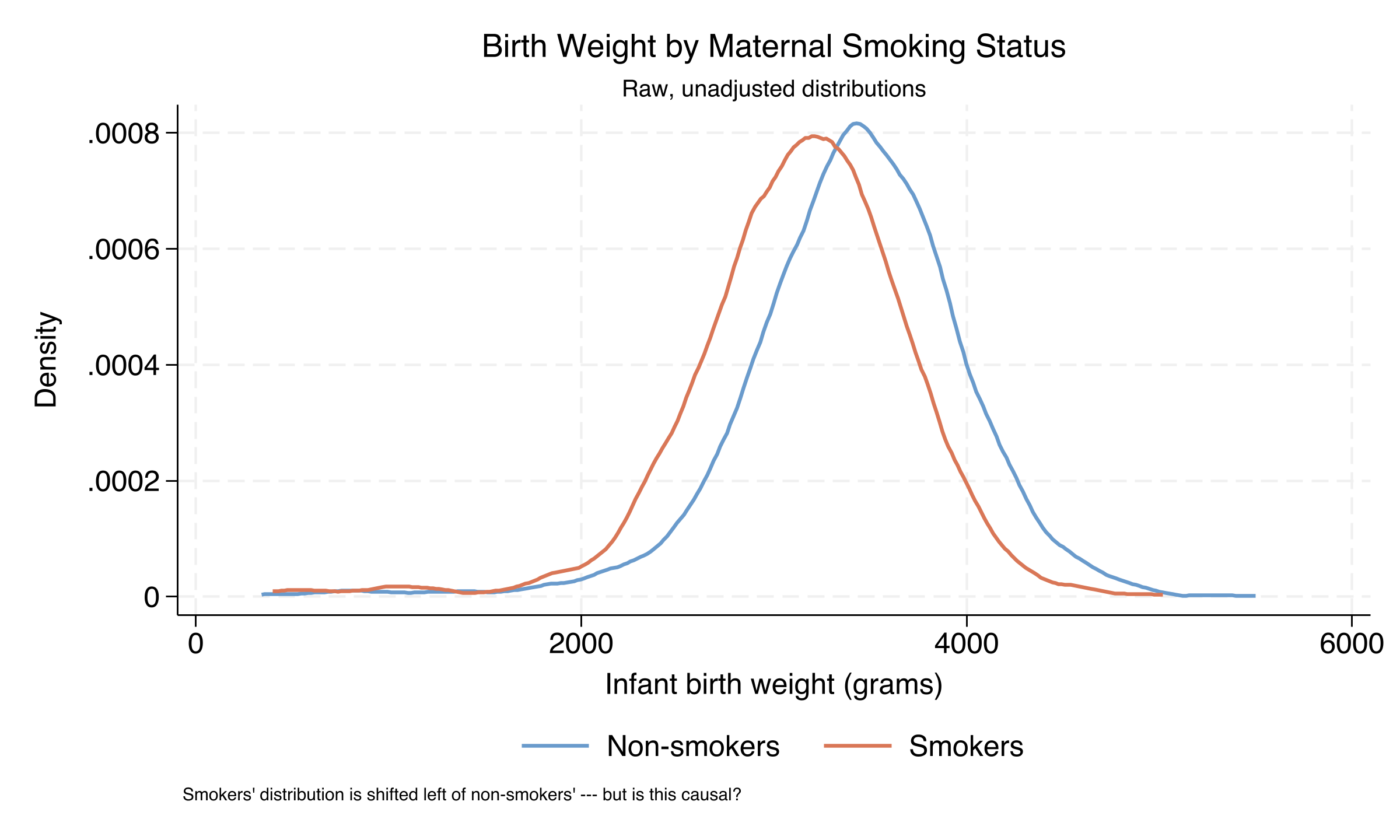
A raw comparison says smokers’ newborns are 275 grams lighter. Striking — and almost certainly wrong as a causal number.
Smokers are younger, less educated, less often married, less likely to seek early prenatal care. Each alone predicts a lighter baby.
One unadjusted shift — and we cannot yet say what causes it
Kernel density of infant birth weight. Smokers’ distribution (orange) sits ~250 g left of non-smokers’ (steel blue) — but the shift conflates smoking with confounders.
Where we’re going
The estimand: ATE and ATT under the potential-outcomes framework
What makes adjustment credible: unconfoundedness + overlap
Six estimators on four routes — outcome, treatment, both, or neither
The payoff: do they agree, and what does it mean if they do?
The Investigation
Act II
The lab: 4,642 births, 864 smokers, six pre-treatment confounders
Outcome\(Y\) — infant birth weight in grams (bweight)
Treatment\(D\) — mother smoked during pregnancy (mbsmoke)
Confounders\(X\) — age, education, marital status, prenatal care, parity, father’s age
Smokers are 18.6% of the sample (864 of 4,642). The minority-treatment imbalance is exactly why a difference of means is risky.
We want one of two averages, not one mother’s effect
Reweight every mother by the inverse of her propensity to smoke — the reweighted sample mimics a randomized experiment.
RA models birth weight; IPW models smoking. They agree to within ~9 g — the first strong signal the effect is real, not a one-model artifact.
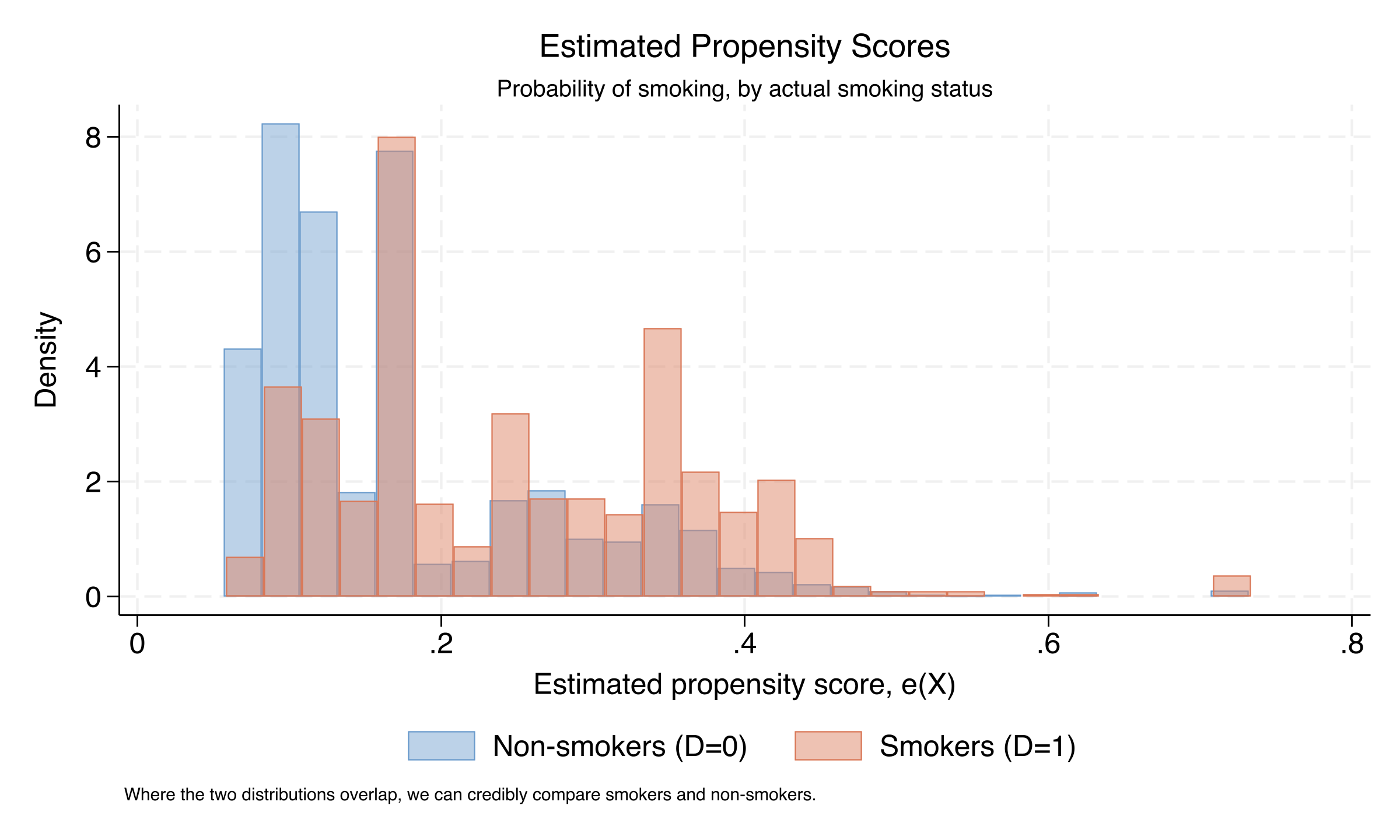
Both distributions span (0,1): overlap holds, so IPW is stable
Estimated propensity scores by smoking status. Non-smokers (steel blue) cluster low, smokers (orange) cluster high — but both span most of the unit interval. No zone where one group is absent.
Doubly robust buys insurance for under a gram: −231.9 g and −232.5 g
IPWRA
RA run with IPW weights
ATE \(=-231.9\) g
consistent if either model is right
AIPW
RA + propensity-weighted residual term
ATE \(=-232.5\) g
attains the efficiency bound
Belt and suspenders: only a simultaneous failure of both models breaks them. They differ by 0.6 g.
NNM fits no model at all — it finds each smoker a statistical twin
For every smoking mother, find her closest non-smoker(s) in covariate space by Mahalanobis distance, then compare birth weights.
teffects nnmatch (bweight mmarried mage fage medu prenatal1) (mbsmoke), /// ematch(mmarried prenatal1) biasadj(mage fage medu) ate* ATE = -210.1 g ATT = -238.5 g
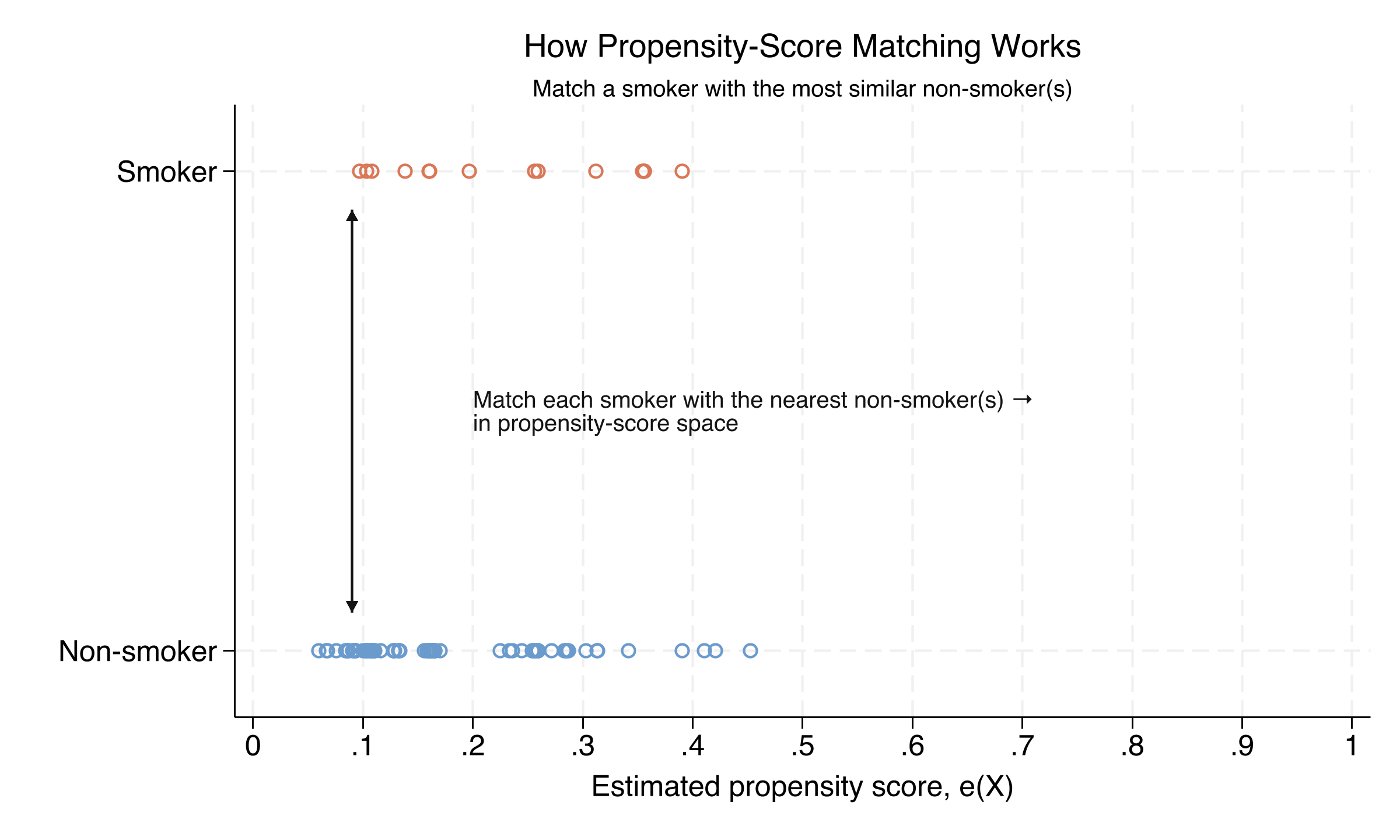
PSM collapses six covariates to one score and matches on it
On a 100-mother subsample: each smoker (orange, top row) is matched to the non-smoker(s) with the closest propensity score. Rosenbaum–Rubin: matching on the scalar score balances every covariate that built it.
The Resolution
Act III
Five very different estimators converge on roughly −230 g
−230 g
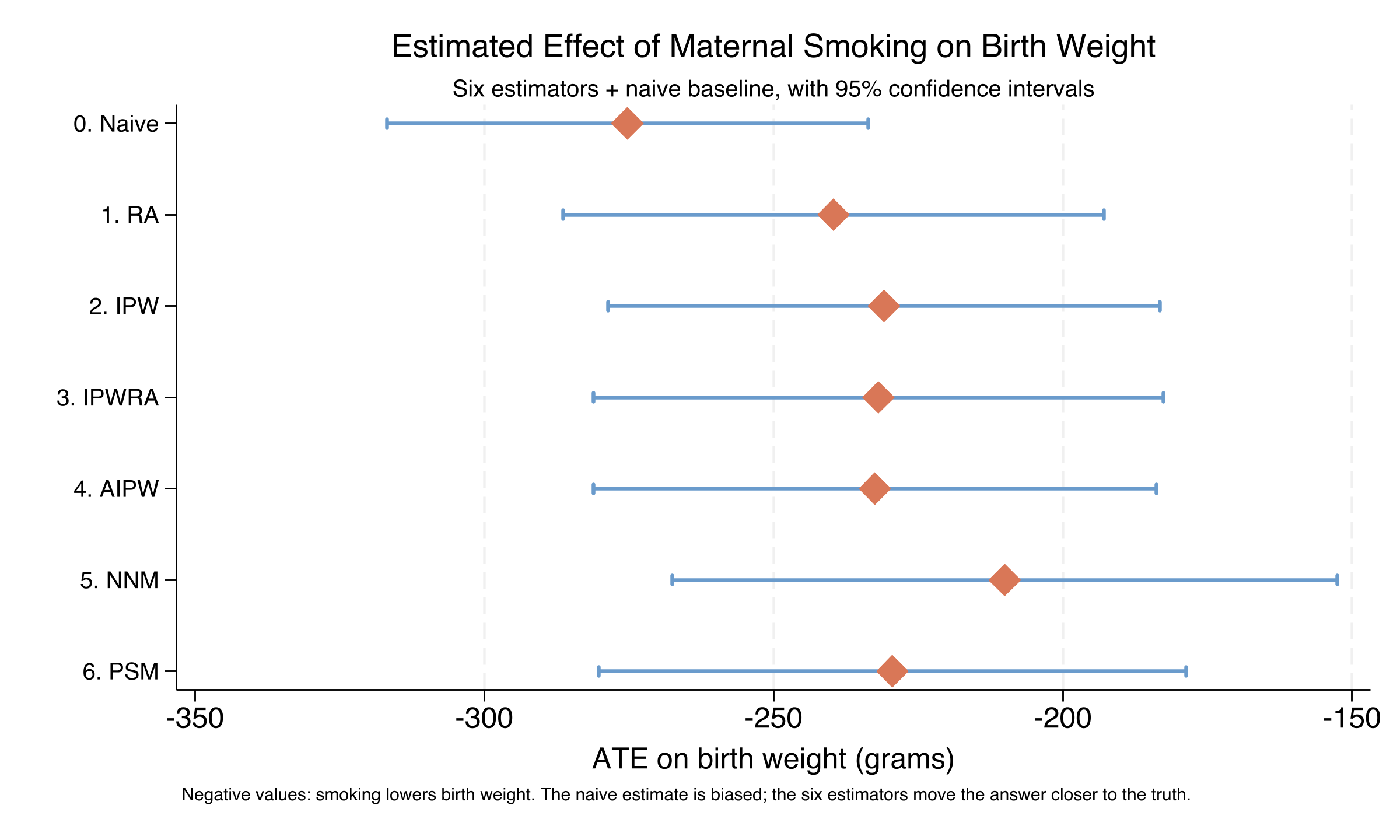
RA, IPW, IPWRA, AIPW, PSM all land between −229 and −240 g; NNM the lone outlier at −210 g
The forest plot: adjustment rules out the naive −275 g
ATE ± 95% CI across seven specifications. The naive estimate (−275 g) is the most negative; six adjusted estimators cluster near −230 g, NNM the slight outlier at −210 g.
ATT can flip the story: for NNM the treated lose more, not less
Estimator
ATE (g)
ATT (g)
RA
−239.6
−223.3
IPW
−230.9
−219.6
IPWRA
−231.9
−220.6
NNM
−210.1
−238.5
PSM
−229.4
−224.6
Four methods: ATT closer to zero than ATE. NNM reverses it — the actual smokers sit where smoking does more damage.
Does matching make this causal? No — two assumptions still carry it
Objection. Machine-matching or reweighting controls cannot manufacture identification.
Response. Correct. The −230 g is identified only under unconfoundedness given \(X\) and overlap. The six methods discipline how we adjust; none rules out an unmeasured confounder — stress, income, nutrition — that drives both smoking and birth weight. Convergence is reassuring, not proof.
When five honest routes agree, trust the −230 g over the −275 g.