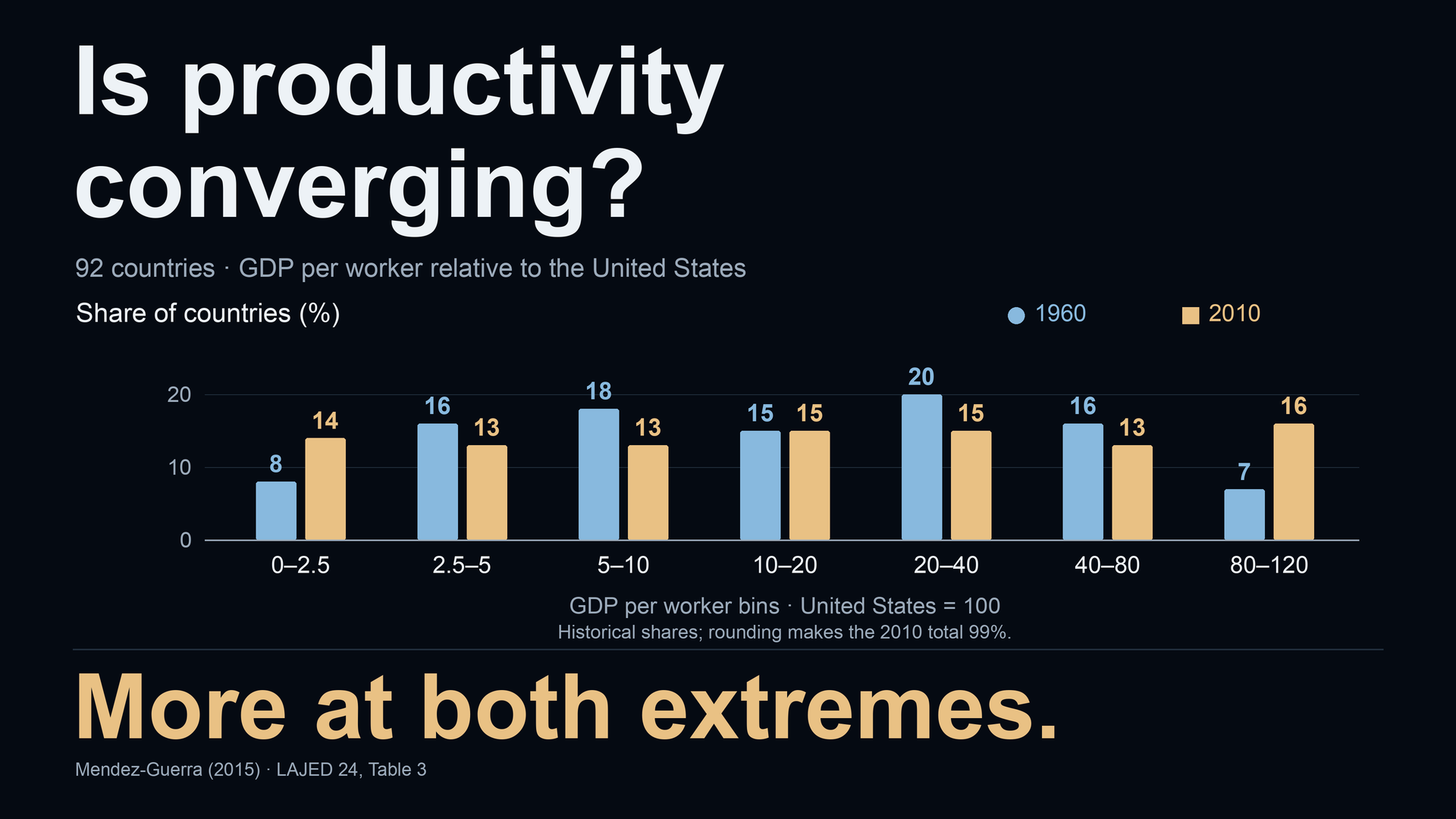
Is productivity converging? Grouped bars compare country shares across seven GDP-per-worker bins relative to the United States, set to 100, in a balanced sample of 92 countries. From 1960 to 2010, the lowest bin, below 2.5, rises from 8% to 14%, and the highest bin, 80 to below 120, rises from 7% to 16%. All seven bins are shown. More countries are at both extremes. Values are descriptive, rounded country shares, not population shares; the 2010 shares total 99% because of rounding. No uncertainty is reported.

The World Productivity Distribution: Convergence and Divergence Patterns in the Postwar Era

Abstract

The post-World War II period has seen substantial changes in labor productivity around the world. Motivated by these changes, this article documents four stylized facts about the world productivity distribution. First, there is a large and increasing disparity between its tails. Second, this disparity rapidly increased in the 1980s, slowed down in the next decade, and stabilized in the mid-2000s. Third, overtime, there has been substantial forward and backward mobility of countries and regions. Forth, the upper tail the distribution is more sensitive to improvements in human capital, while the lower tail is more sensitive to improvements in technology. The article concludes pointing out that, at least in the near future, the world productivity distribution may still be characterized by divergence at the bottom, and convergence and overtaking at the top.

Publication
Latin American Journal of Economic Development, 24(2)
Carlos Mendez
Carlos Mendez
Associate Professor of Development Economics

My research interests focus on the integration of development economics, spatial data science, and econometrics to better understand and inform the process of sustainable development across regions.

Related