Human Capital Constraints, Spatial Dependence, and Regionalization in Bolivia: A Spatial Clustering Approach
Abstract
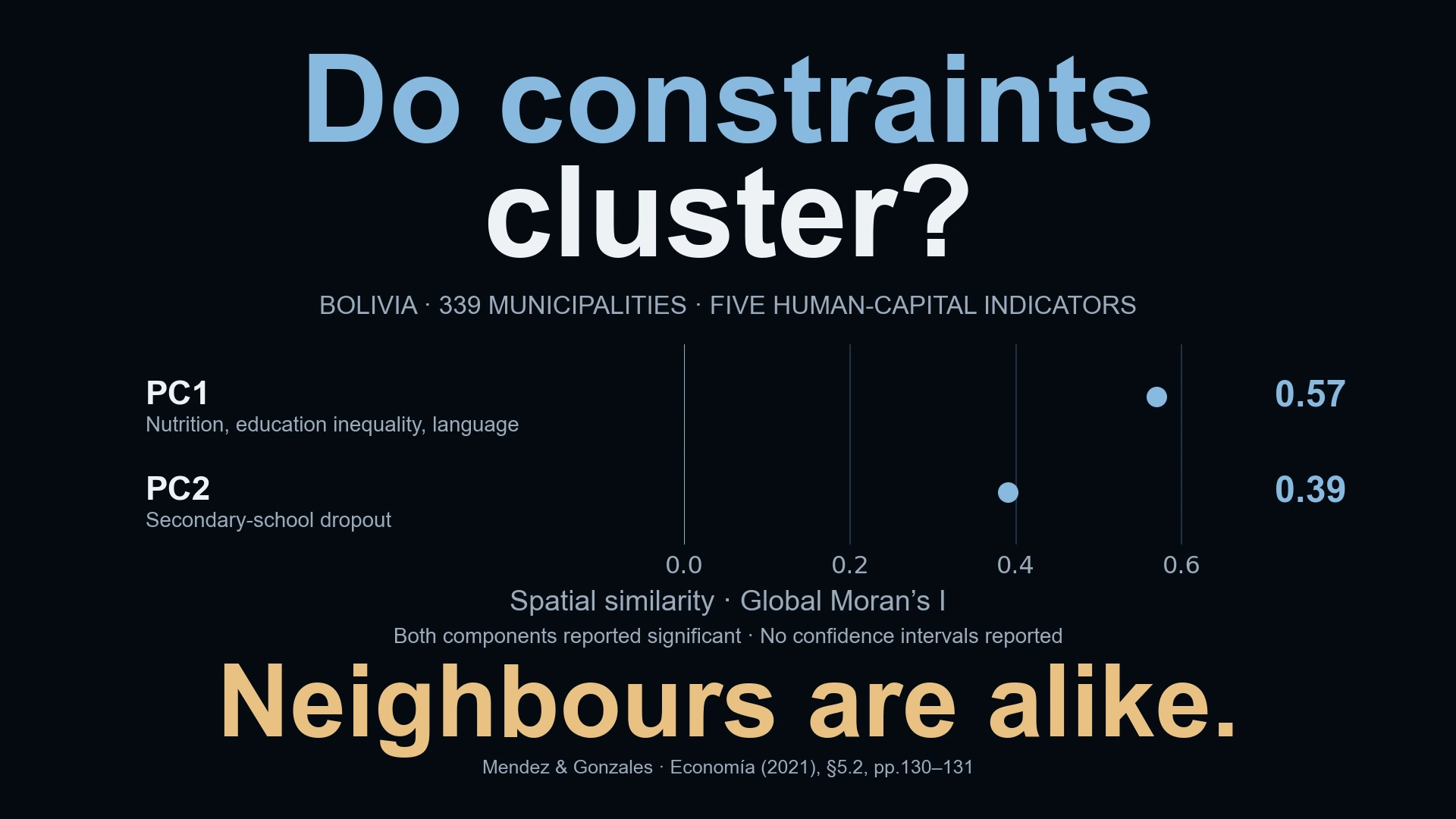
Using a novel dataset, this article studies the spatial distribution of human capital constraints across 339 municipalities in Bolivia. In particular, five human capital constraints are evaluated: chronic malnutrition in children, non-Spanish speaking population, secondary dropout rate of males, secondary dropout rates of females, and inequality in years of education. Through the lens of principal components, spatial dependence, and regionalization methods, the municipalities are endogenously classified according to their similarity in human capital constraints and geographical location. Results from the spatial dependence analysis indicate the specific location of significant hot spots (high-value clusters) and cold spots (low-value clusters). A Regionalization analysis of the constraints indicates that Bolivia can be regionalized into seven or eight geographical regions. The article concludes discussing the potential complementary of these two analyses and their usefulness in identifying the location of policy priorities.

Carlos Mendez
Associate Professor of Development Economics
My research interests focus on the integration of development economics, spatial data science, and econometrics to better understand and inform the process of sustainable development across regions.