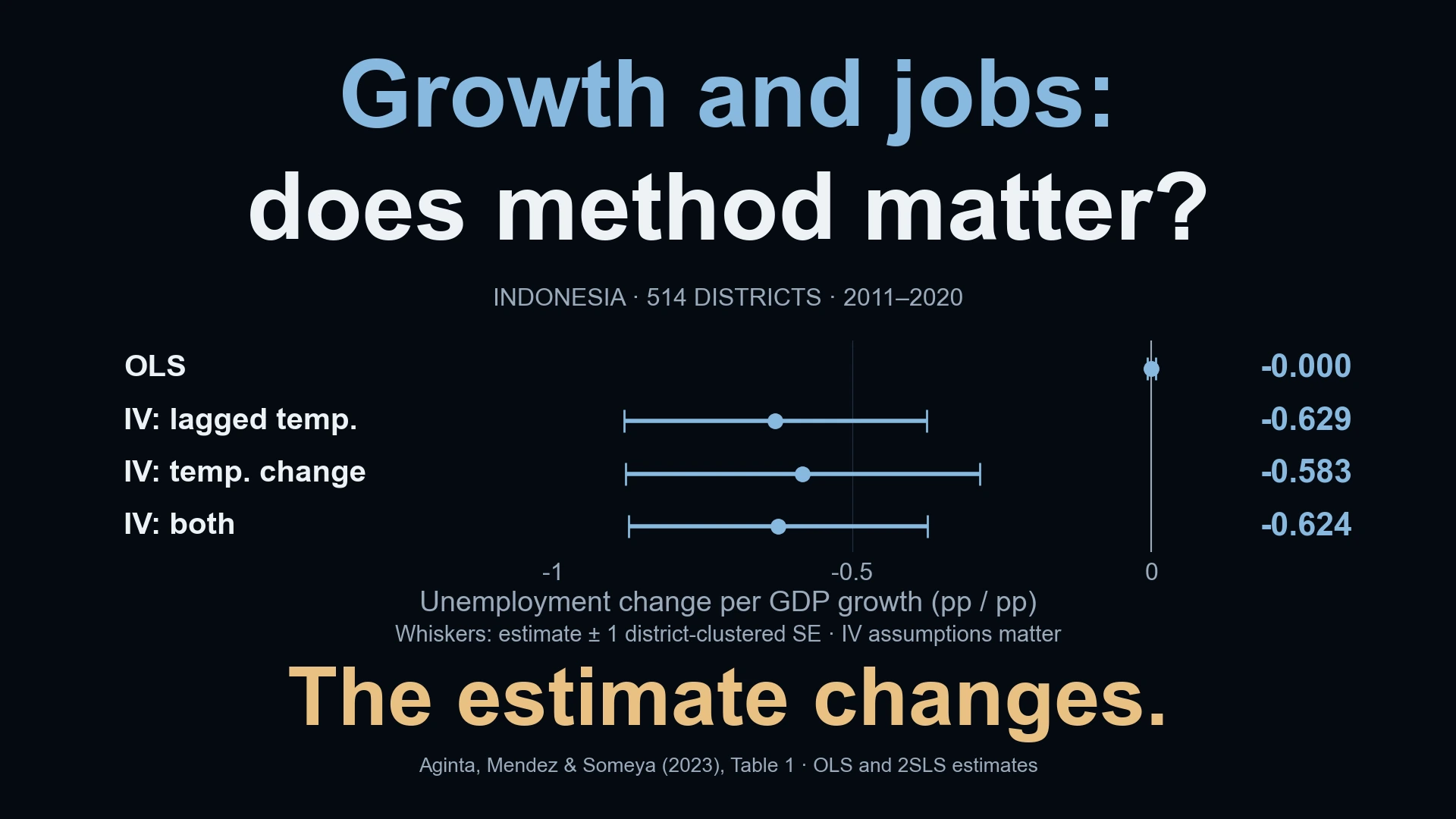
Growth and jobs: does method matter? Across 514 Indonesian districts, 2011–2020, the reported unemployment-change coefficient per percentage point of GDP growth is −0.000 under OLS, −0.629 using lagged temperature as an instrument, −0.583 using temperature change, and −0.624 using both. Whiskers show ±1 district-clustered standard error: 0.007, 0.253, 0.296 and 0.250. All models include district and year fixed effects. The estimate changes with method. Instrumental-variable interpretation requires validity and relevance assumptions; −0.000 is a rounded estimate, not proof of no relationship.

Regional Okun’s law and endogeneity: evidence from the Indonesian districts

Abstract

This paper investigates the regional Okun’s law across 514 districts of Indonesia over the 2011–2020 period. To handle the endogeneity issue, we apply a two-stage least squares (2SLS) model and use regional temperature as instrument for economic growth. Our results show that the Okun’s coefficient becomes statistically significant only after endogeneity is addressed. Consistent with the prevalent economic divide between the western and eastern regions of Indonesia, we find that Okun’s law applies solely to the more industrialized western regions.

Publication
Applied Economics Letters
Carlos Mendez
Carlos Mendez
Associate Professor of Development Economics

My research interests focus on the integration of development economics, spatial data science, and econometrics to better understand and inform the process of sustainable development across regions.

Related