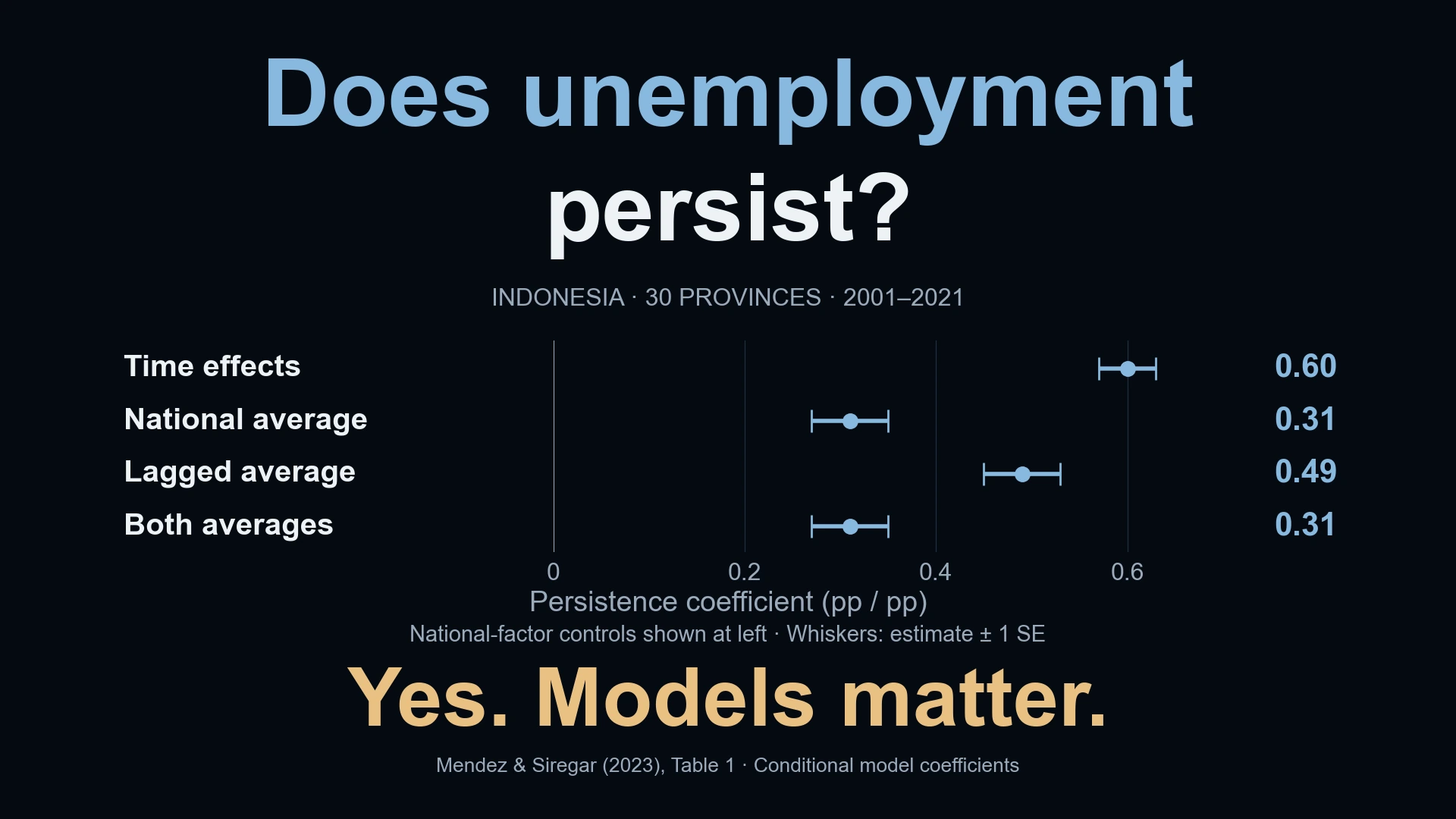
Does unemployment persist? In 30 Indonesian provinces during 2001–2021, the time-lag unemployment coefficient is 0.60 with time effects, 0.31 with the contemporaneous national average, 0.49 with its lag, and 0.31 with both averages. Whiskers show estimate ±1 reported standard error: 0.03, 0.04, 0.04 and 0.04, respectively. Units are percentage points per percentage point. All models include regional effects and spatial dynamics. Persistence is positive, but its size depends on the model; these are conditional coefficients, not total causal effects.

Regional unemployment dynamics in Indonesia: Serial persistence, spatial dependence, and common factors

Abstract

We analyze the space-time dynamics of Indonesia’s provincial unemployment by simultaneously accounting for their serial persistence, spatial dependence, and common factors. The results show that unemployment rates vary widely across provinces, but have similar patterns over time, indicating the presence of common latent factors. Using the average national unemployment rate as a proxy for common factors, the results indicate that the space-time dynamics of provincial unemployment are characterized by both significant serial persistence and spatial dependence. The results also quantify which regions are most sensitive to national unemployment shocks, providing a deeper understanding of regional unemployment heterogeneity.

Publication
Letters in Spatial and Resource Sciences
Carlos Mendez
Carlos Mendez
Associate Professor of Development Economics

My research interests focus on the integration of development economics, spatial data science, and econometrics to better understand and inform the process of sustainable development across regions.

Related