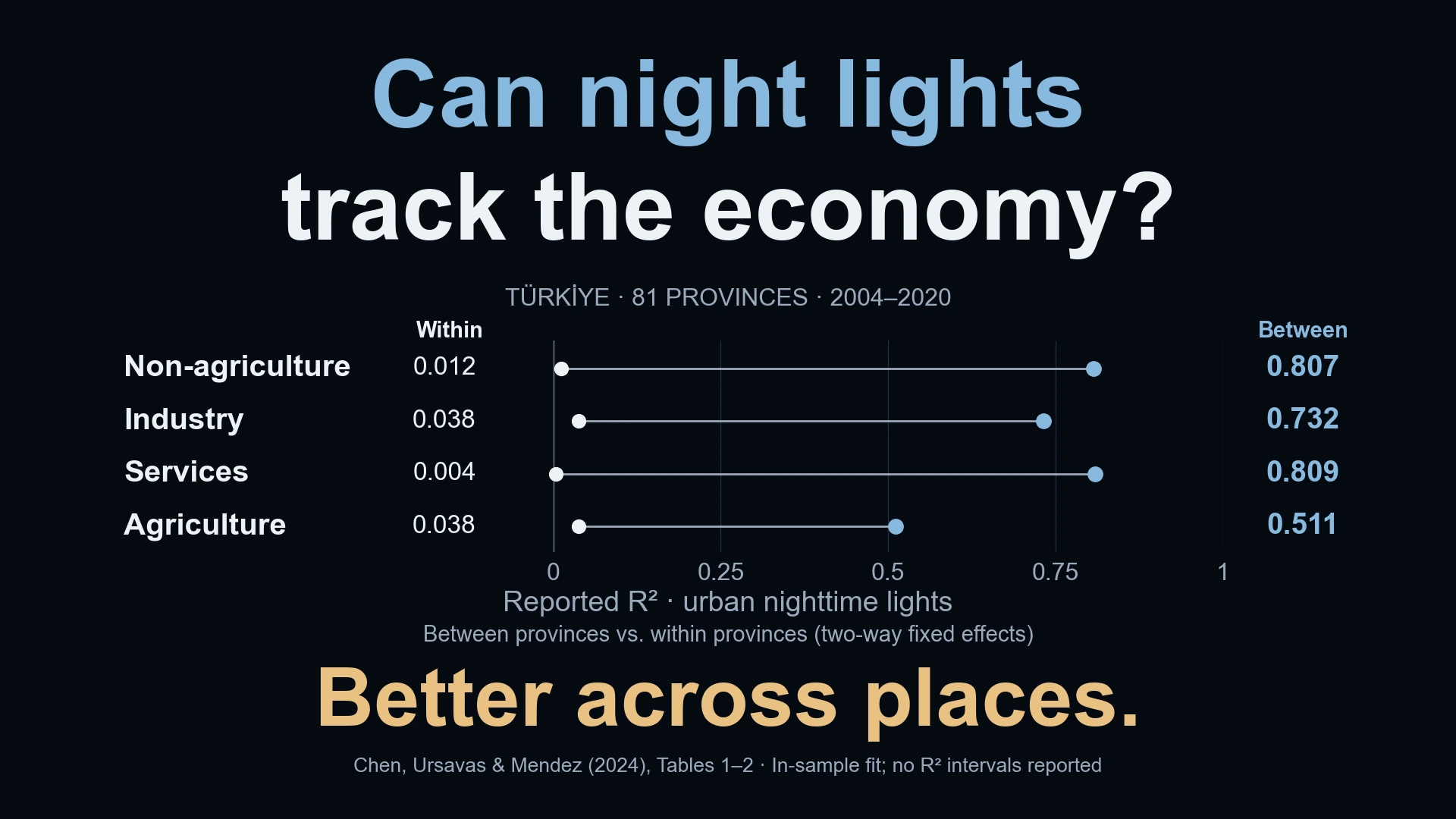
Can higher-quality nighttime lights predict sectoral GDP across subnational regions? Urban and rural luminosity across provinces in Türkiye
Abstract
Limited access to regional and sectoral economic data hinders effective policy design in various countries. To address this issue, this study explores the potential of higher-quality nighttime light (NTL) data to predict economic activity across various sectors within regions. We analyze the relationship between NTL intensity and sectoral GDP in 81 Turkish provinces from 2004 to 2020. Our findings reveal that urban NTL data is most strongly correlated with non-agricultural GDP, particularly in the industrial sector. This suggests that NTL data, especially its urban component, can be a valuable tool for policymakers to identify economically disadvantaged regions and sectors, monitor the impact of economic development policies at a granular level, and allocate resources efficiently. However, this study also acknowledges limitations in capturing annual GDP changes, highlighting the need to combine NTL data with other economic indicators for a comprehensive understanding.

Carlos Mendez
Associate Professor of Development Economics
My research interests focus on the integration of development economics, spatial data science, and econometrics to better understand and inform the process of sustainable development across regions.